
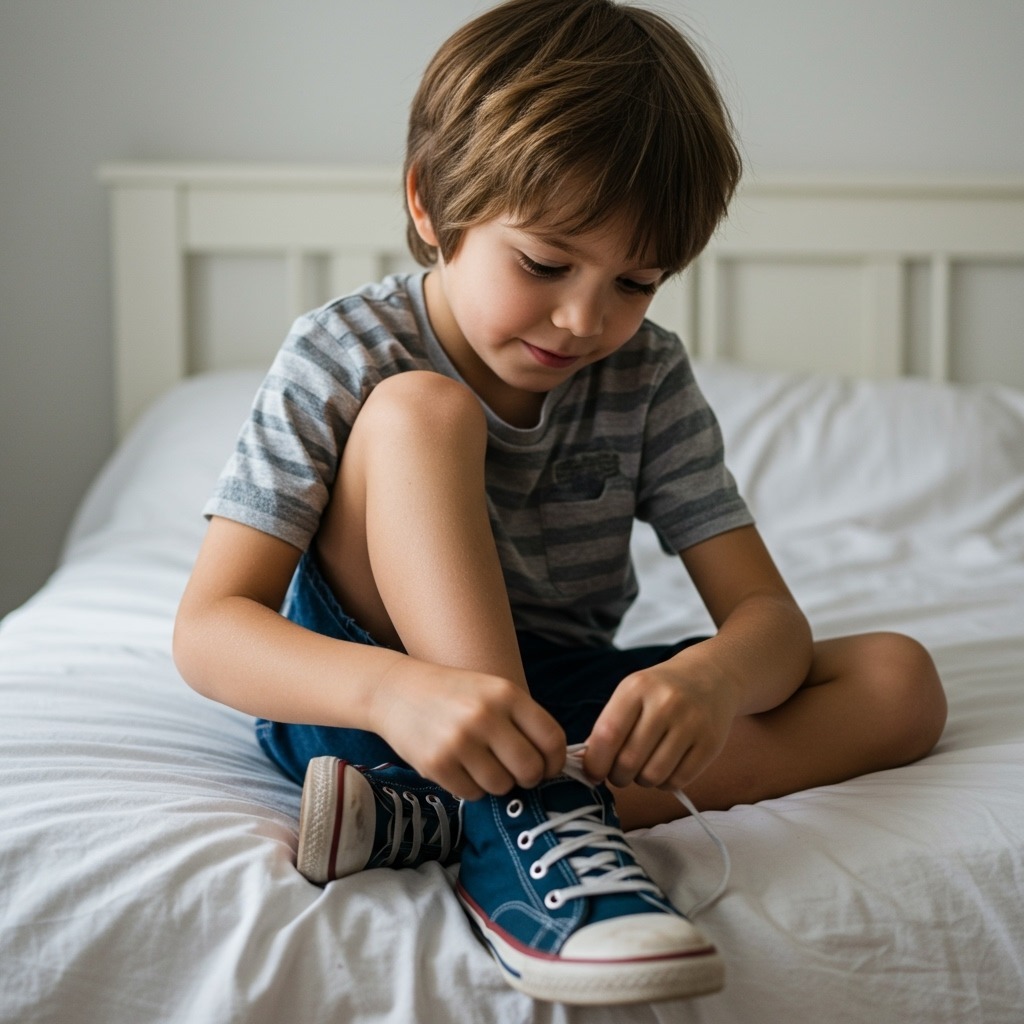
Last spring, I watched my seven-year-old try to tie his shoes for the fifteenth time. His fingers fumbled with the laces, his face scrunched in concentration, and I could see the frustration building. My first instinct? To just tie them for him so we could get out the door on time.
But then I stopped myself. I realized I’d been doing that a lot—tying shoes, picking out clothes, packing lunches, solving every small problem. And I was accidentally robbing my kids of something crucial: confidence.
That’s when I started paying attention to life skills for 5-8-year-olds. Not just random tasks, but the foundational abilities that help kids feel capable, independent, and ready to handle the world. The skills that say, “I can do hard things. I don’t need an adult to solve every problem for me.”
Here’s what surprised me: once I started teaching these skills intentionally, everything shifted. My kids became more independent. They felt MORE confident, not less. And honestly? My stress went down because I wasn’t constantly jumping in to “fix” everything for them.
I’m sharing every life skill I’ve taught my kids, why it matters, and exactly how to teach them without losing your mind. These aren’t advanced skills—these are the foundational abilities that set kids up for success in school, friendships, and life.
Why Teaching Life Skills Matters More Than You Think
Here’s something schools don’t teach and parenting books often skip over: kids who can do things for themselves are significantly more confident and resilient.
I used to think that helping my kids constantly was showing them love. But what I learned is that real love sometimes means stepping back. When kids figure things out themselves—even small things like tying their shoes or packing their backpack—their brains release dopamine. They feel proud. They feel capable. They feel like, “Hey, I can actually DO things.”
How to make your kids mentally strong emphasizes that age-appropriate independence is crucial for developing self-esteem and problem-solving skills. Kids who learn life skills early develop better executive function, which helps them succeed academically and socially later on.
Plus, here’s the honest part: teaching your kids life skills means you have more breathing room. When your second-grader can pour their own cereal, pack their own lunch, and get themselves dressed, you’re not starting every morning from a place of overwhelm.
Personal Care Skills Every 5-8-Year-Old Should Master.
These are the daily hygiene and self-care tasks that make kids feel independent and responsible.
Using the Toilet Independently might seem basic, but by age 5, kids should be able to use the bathroom with minimal help—and this includes wiping, flushing, and handwashing. If your child is still having accidents or needs significant help, this is a gentle place to start. Some kids take longer, and that’s okay. The key is consistency and patience.
Bathing and showering a skill kids should start learning around age 6. Start by washing their hair and body while supervising. Gradually have them do more. By age 7-8, they should be able to shower mostly independently (though you’ll still supervise for safety). Teach them to check the water temperature, how to use soap, and the importance of getting clean. Make it fun—I let my kids pick their own soap and gave them a “shower chart” so they could check off each step.
Brushing Teeth should be happening twice daily by this age. Kids can start doing this independently around age 5-6, though you’ll need to supervise to make sure they’re actually brushing and not just pretending. The American Dental Association recommends that children brush for a full two minutes, which is why I set a timer and made it a game.
Handwashing is one of the most important life skills for 5-8-year-olds because it prevents illness. Teach the “20-second rule”—singing “Happy Birthday” twice while they wash. Make sure they understand the sequence: wet hands, apply soap, scrub for time, rinse, dry. Post a picture chart in the bathroom as a visual reminder.
Getting dressed should be completely independent by age 6-7. This includes picking out weather-appropriate clothes (with guidance), putting on shirts and pants correctly, fastening buttons and zippers, and choosing matching socks. I started by letting my kids pick from two outfit options I pre-approved so they felt in control, but I maintained some guidance.
Hair brushing and Basic Grooming are something kids can start learning around age 5. Show them how to brush their hair, and by age 7-8, they should be doing it mostly independently. For boys, this might include basic face-washing to prevent acne as they get older.

Kitchen and Food Skills
Teaching kids to handle food builds competence and is crucial for their future independence.
Pouring Liquids should start around age 5-6 with water in lightweight cups or pitchers. Start with short distances and small amounts. By age 7-8, kids should be able to pour milk and juice without spilling too much. Yes, there will be spills—that’s part of learning.
Using Utensils Properly means kids should be eating with a fork, knife, and spoon by age 6. By age 7-8, they should understand basic table manners like chewing with their mouth closed and using napkins. Our guide on basic manners for kids covers this in depth if you need more structured help with this skill.
Preparing Simple Meals is a game-changer. By age 6-7, kids can help make sandwiches (with supervision for knife work). By age 7-8, they can make their own cereal, toast, or a simple lunch. Start by breaking down the task into steps and supervising closely. The sense of pride they get from making their own lunch is incredible. Check out our collection of easy recipes for kids for age-appropriate cooking projects.
Setting the Table teaches responsibility and coordination. By age 5-6, kids can place plates and cups. By age 7-8, they can set a complete table with all utensils and napkins. This task connects to positive discipline techniques for toddlers in that it teaches natural consequences—if they don’t set it, dinner can’t happen.
Clearing Dishes is a natural next step. Kids can clear their own place by age 5-6. By age 7-8, they should help clear the whole table and load the dishwasher (with guidance on placement).
Using a Water Bottle might seem small, but kids should be able to open, drink from, and close their own water bottle by age 5-6. This skill prevents spills and builds independence at school.
Dressing and Clothing Skills
Independence with clothing goes beyond just putting on clothes—it includes understanding their own needs and preferences.
Buttoning and Zipping are fine motor skills that develop around age 4-5, but kids should have these mastered by age 6-7. Practice with loose buttons on old clothing before asking them to manage their own clothes daily.
Tying Shoes is a classic life skill. Kids typically can do this between ages 5-7, though it varies widely. Don’t stress if your child isn’t there yet. Use the bunny ears method (two-loop method) as it’s easier than the traditional single-loop method. We spend weeks on this skill in our house—it’s worth the time investment because it represents a real milestone.
Choosing Weather-Appropriate Clothing is something kids can start doing around age 6-7 with guidance. Ask them, “What’s the weather like today?” Help them connect weather to clothing choices. By age 7-8, they should be doing this mostly independently with just a parent check-in.
Putting Away Clean Clothes teaches organization. By age 5-6, kids can help fold (loosely) and put away clothes. By age 7-8, they should have a designated drawer or closet section where they can put their own clean clothes away independently.
Hygiene and Health Skills
These skills create healthy habits that will last a lifetime.
Blowing Their Nose might seem simple, but it’s a learned skill. Kids can usually do this by age 4-5. Teach them to blow gently into a tissue, not sniff.
Coughing and Sneezing Into Their Elbow is crucial for health and was reinforced during COVID. Kids should understand this by age 5-6 and practice it consistently.
Asking for Help When Sick is important. Kids should be able to tell you when they don’t feel well, where it hurts, and what they need. Practice by asking them how they feel regularly.
Taking Medicine Independently (with supervision) is a skill for older kids in this range. By age 7-8, kids can take a pill or liquid medicine with water if you prepare it for them.

Household and Organization Skills
Teaching kids to manage their environment builds responsibility and executive function.
Making Their Bed is a foundational chore. Kids can start learning this around age 4-5, but by age 6-7, they should be pulling a blanket up and arranging pillows. By age 7-8, they should be able to do a decent job independently, even if it’s not magazine-worthy.
Putting Toys Away should happen regularly. Start with bins or baskets organized by toy type. Kids should understand the concept of “cleaning up” by age 4-5 and be mostly independent by age 7-8. Make it fun with music or timers rather than punitive.
Packing Their Own Backpack is crucial for school success. By age 6-7, kids can help pack with a checklist (pictures for non-readers). By age 7-8, they should be mostly independent with just a parent reminder to check they have everything.
Following a Chore Chart teaches responsibility. Create a visual chart with pictures for younger kids or words for older kids. Include 2-3 age-appropriate chores. How to set boundaries for kids explains how consistent chores with clear expectations build healthy discipline.
Sorting Laundry is a task even young kids can help with. By age 5-6, kids can help sort clothes into piles. By age 7-8, they can separate lights and darks mostly accurately.
Feeding and Watering Pets (if you have them) teaches responsibility for living things. This should be part of their daily routine by age 6-7.
Social and Emotional Skills
These life skills impact how kids interact with the world.
Using Polite Words like please, thank you, and excuse me should be automatic by age 5-6. Remind gently and model constantly. By age 7-8, they should use these without reminding most of the time.
Greeting Others Appropriately includes making eye contact, saying hello, and shaking hands. This is something you teach through modeling and gentle reminders.
Expressing Emotions Appropriately means kids can identify and name their feelings, then express them without hurting others. This is an ongoing skill. Teaching emotional vocabulary helps tremendously. Our collection of affirmations for kids can support this emotional development.
Asking for Help is crucial. Some kids are naturally independent to the point of struggle. Teach them that asking for help is a sign of strength, not weakness. Model asking for help yourself.
Playing cooperatively requires turn-taking, sharing, and understanding rules. By age 7-8, kids should be able to play games with others, handle losing without major meltdowns, and work as part of a team.

Safety Skills Every Child Needs
These life skills could literally save your child’s life.
Knowing Their Address and Phone Number should be memorized by age 7-8. Practice regularly. Some kids find it helpful to sing it to a familiar tune.
Knowing what to do in an Emergency includes understanding when to call 911 and how to provide basic information. Practice scenarios in a calm way without scaring them.
Road Safety includes looking both ways before crossing, understanding traffic lights, and holding an adult’s hand when necessary. Kids should understand these concepts by age 5-6 and be practicing them by age 7-8.
Stranger Safety is about understanding which adults they can trust (police officers, store employees, parents of friends) and when to ask for help. The National Center for Missing & Exploited Children has age-appropriate resources for teaching this skill.
Fire Safety includes knowing how to get out of the house quickly and meeting at a designated spot. Have a fire drill as a family annually.
Water Safety includes understanding pool rules, wearing a life jacket if needed, and never going near water alone.
Problem-Solving and Decision-Making Skills
These higher-level skills are just as important as daily tasks.
Making Simple Choices starts young. By age 5-6, kids can choose between two options (“Do you want carrots or apples for a snack?”). By age 7-8, they can handle more open-ended choices (“What do you want for lunch?”).
Understanding Consequences is crucial. When you set a boundary (like a screen time limit), follow through consistently so kids understand that actions have consequences. This teaches them to think before acting.
Problem-Solving With Guidance involves helping kids think through options. When they come to you with a problem, instead of solving it, ask: “What are some ways you could handle this?” This builds their critical thinking muscles.
Handling Mistakes is a life skill we often forget to teach. When kids mess up, help them see it as a learning opportunity, not a failure. Ask, “What did you learn? What would you do differently?”
Age-Specific Teaching Strategies
Ages 5-6: Use lots of modeling and visual reminders. Picture charts are your friend. Be specific with praise: “I noticed you tied your shoes all by yourself! That shows persistence!” Make everything fun and game-like.
Ages 7-8: Kids can follow multi-step instructions and understand natural consequences better. They’re developing internal motivation, so emphasize how capable they are. Some kids start responding well to simple reward systems (not bribes, but natural consequences—”When you pack your own lunch, you get to pick the dessert”).
Common Mistakes Parents Make
Doing It Faster Yourself: Yes, it’s faster if you tie your shoes. But you’re teaching your kid they can’t do it. Slow down. Give them the time.
Not Being Patient With Mistakes: Kids will spill milk. They’ll forget steps. That’s learning. Get over it. (I say this with love.)
Making It Too Complicated: “Make your bed” doesn’t mean hospital corners. It means pulling up the blanket. Start simple.
Giving Up Too Soon: If your child tries once and it’s hard, they’ll want to quit. Encourage them to try again. Persistence is a skill.
Not Celebrating the Wins: When your kid does something independently, act like it’s a big deal. Because it is.
Frequently Asked Questions
My child resists learning these skills. Should I just do it for them?
Short answer: no. Resistance is normal. Kids like the comfort of having someone else do things for them. But you’re teaching a crucial message: “I believe in you. You’re capable.” Start with one skill. Make it fun. Celebrate small progress. Don’t expect perfection. If they resist strongly, it might mean the skill is too advanced—try again in a few months. But don’t let resistance stop you from trying.
What if my child is behind their peers in these skills?
First, developmental ranges are wide. A child who can’t tie shoes at 6 but can at 7.5 is completely normal. If you’re concerned about significant delays across multiple skills, mention it to your pediatrician. Otherwise, focus on consistent practice and encouragement without pressure. Every child develops at their own pace.
Should I reward my child for doing these skills?
Natural consequences are better than rewards. “When you get dressed by yourself, we have more time to play before school.” But if your child is really struggling with motivation, a simple reward system (stickers leading to small rewards) can help initially. The goal is to move toward intrinsic motivation—doing things because they’re proud of themselves, not because they’ll get something.
How do I teach these skills without nagging constantly?
Routines and visual reminders help more than nagging. A picture chart on the wall showing morning routine steps means you’re not saying “brush your teeth” every single day. Natural consequences also help—if they don’t pack their backpack, they forget their homework. Let that happen (within reason) because the lesson sticks better than your reminding them.
What if my child forgets a skill they already learned?
That’s regression, and it’s completely normal, especially under stress or when routines change. Don’t shame them. Just remind gently and practice again. Their brain are still developing executive function, so some forgetfulness is expected.