
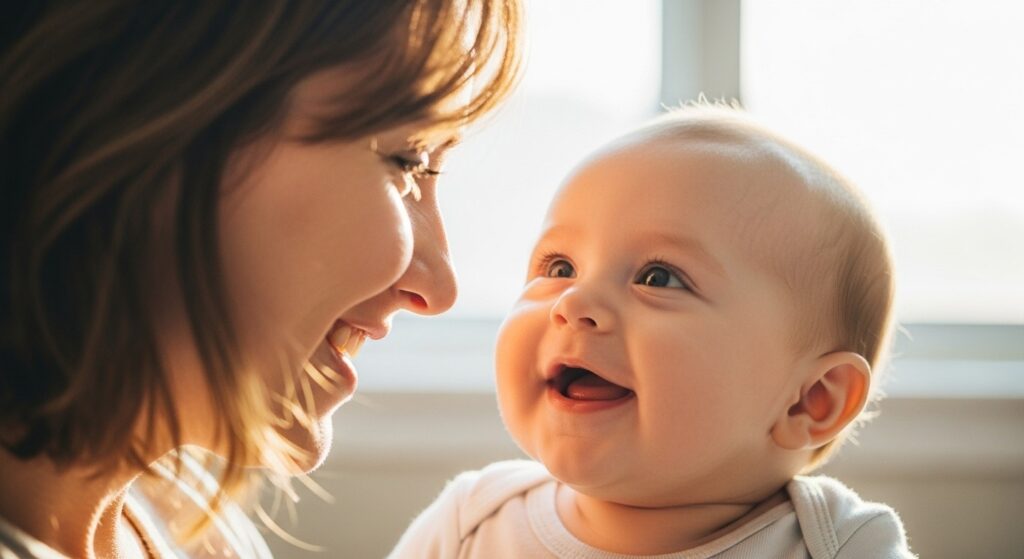
I was changing my daughter’s diaper at 7 weeks old when it happened. She looked directly at me, and her entire face lit up with the biggest, gummiest grin I’d ever seen. Her eyes crinkled. Her whole body wiggled. And I… completely froze because my phone was across the room and I had nothing to capture this moment.
“Did you just smile at me?” I whispered, half-crying, half-laughing. “Do it again, please do it again!”
Of course, she didn’t. The moment passed, and I was left standing there with a half-diapered baby, wondering if I’d actually just witnessed my daughter’s first real smile or if I’d imagined the whole thing.
If you’re reading this at 2 a.m. Googling “when do babies start smiling” while staring at your sleeping newborn’s face, I get it. You’re desperate for that first smile. You’re watching for it like a hawk. And you’re probably wondering if every tiny mouth twitch counts.
Here’s everything I learned about when babies start smiling—including the difference between those early “smiles” and the real deal that will absolutely melt your heart.
When Do Babies Start Smiling? (The Real Answer)
Let me cut straight to the answer you’re looking for: most babies start showing their first real, genuine, social smiles somewhere between 6 and 8 weeks old, with many hitting this milestone closer to 2 months.
But here’s the thing that confused me as a new mom: you might see your baby “smile” way earlier than that. I swear my daughter smiled at 3 days old. Except… she didn’t. Not really.
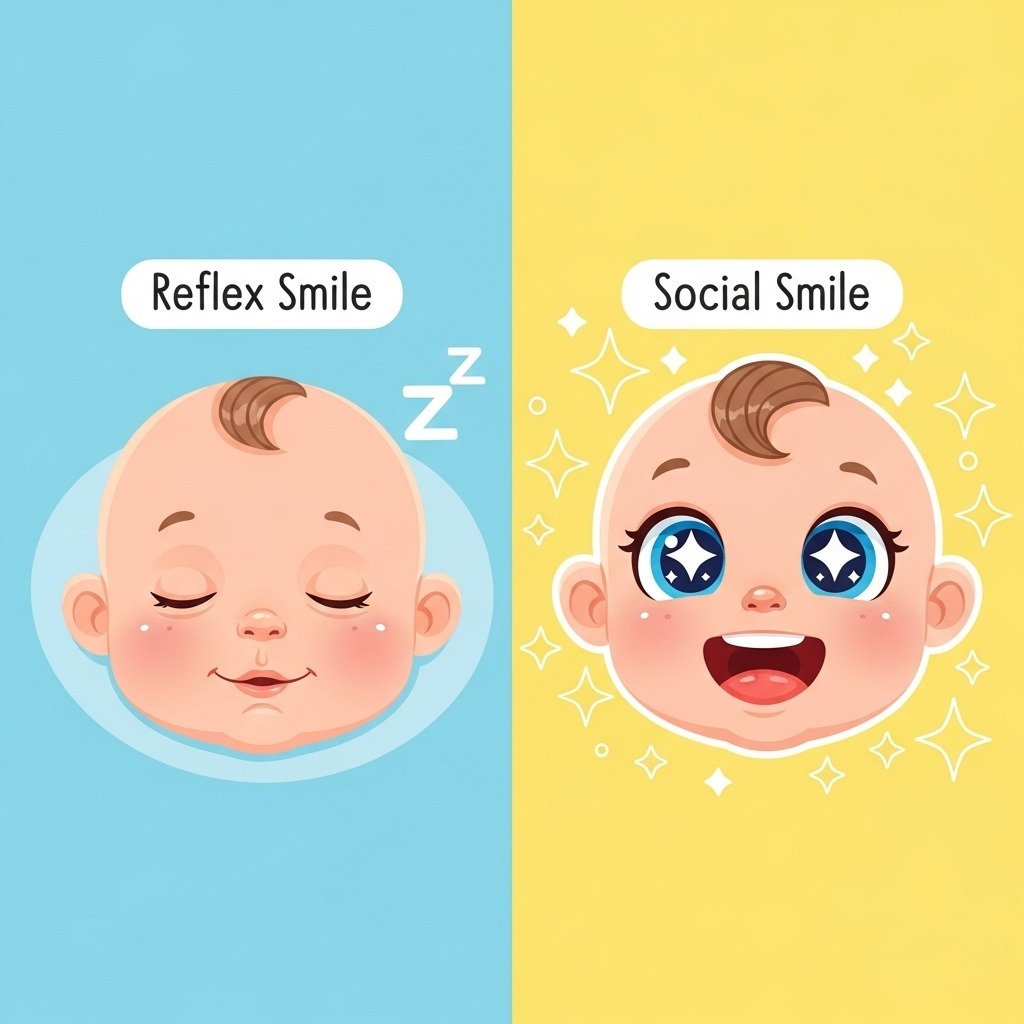
Those early smiles are called reflex smiles, and they’re totally different from the social smiles you’re waiting for. According to the American Academy of Pediatrics, true social smiles typically appear by the end of the second month, and they’re an important developmental milestone that shows your baby’s nervous system, vision, and hearing are all maturing right on schedule.
The timeline looks something like this:
- Birth to 6 weeks: Reflex smiles only
- 6-8 weeks: First responsive, social smiles start appearing
- 2-3 months: Consistent, purposeful smiling in response to you
- 3-4 months: Smiling at everyone and everything they find interesting
If your baby was born prematurely, pediatricians count from their due date rather than their birth date when tracking milestones like smiling. So if your baby arrived 4 weeks early, expect their first social smile around 10-12 weeks after birth.
The Newborn Smile Reflex (It’s Not What You Think)
During those first few weeks, I was convinced my daughter smiled at me multiple times. She’d be lying in her bassinet, and suddenly this little grin would cross her face. I’d grab my husband: “Look! She’s smiling!”
He’d look at me gently and say, “Babe, she’s asleep.”
Ugh. He was right.
Those early newborn smiles are called reflex smiles, and they happen randomly—often during sleep, especially during REM sleep. They’re not in response to anything you’re doing. They’re just your baby’s face practicing movements and expressions, similar to how they practice sucking, blinking, and other reflexes while still in the womb.
Experts think reflex smiles might be triggered by internal stimulation, like passing gas (yes, really) or just random brain activity during sleep. Some babies never show reflex smiles at all, while others do them constantly. Neither scenario means anything about your baby’s development or personality.
Reflex smiles are typically:
- Very brief (lasting just a second or two)
- Often lopsided or crooked
- Happens when the baby is sleepy or asleep.
- Don’t make eye contact or engage.
- Sometimes looks more like a grimace than a smile.
I actually found it kind of funny once I understood what was happening. My daughter would be sound asleep, let out a little toot, and then smile in her sleep. We called them her “gas smiles,” and while they were adorable, they definitely weren’t the meaningful connection I was craving.
The good news? These reflex smiles are preparing your baby’s facial muscles for the real smiles to come. They usually disappear around 2 months old—right around the same time social smiles begin. It’s like your baby’s face is warming up for the main event.
Your Baby’s First Real (Social) Smile
So how do you know when you’ve finally witnessed a real, genuine, “I’m smiling because I’m happy to see you” smile?
Trust me, you’ll know. The difference is unmistakable once you see it.
Social smiles happen when your baby is awake and alert. They last longer than reflex smiles—sometimes several seconds. Most importantly, they happen in response to something: your face, your voice, your exaggerated expressions. Your baby will make direct eye contact with you, and the smile will reach their eyes. The whole experience feels like a conversation, even though no words are being exchanged.
When I finally figured out that my daughter’s 7-week diaper-change smile was the real deal, I started noticing the pattern. She’d smile when I leaned over her crib in the morning. She’d grin when I sang her favorite song. She’d light up when my husband made silly faces. These weren’t random—they were responses.
Pediatricians explain that social smiling is a major milestone because it signals that babies can now focus on faces and eyes, and they’re beginning to understand that smiles are a form of communication. Your baby is basically saying, “I see you, I recognize you, and I’m happy you’re here.”
Here’s something that might sting a little: your baby might not give YOU their first social smile. My daughter’s very first real smile went to her grandmother, and I was devastated. I’d been working so hard for that smile! But here’s what I learned: babies smile at whoever is engaging with them in that moment. It’s not about who they love more—it’s about who’s making funny faces or cooing at them right then.
Some babies are also just more smiley than others, and that’s totally a temperament thing. Just like how some adults are naturally more smiley and others are more reserved, babies have their own personalities from day one.
The Complete Timeline of Baby Smiles (What to Expect)
Understanding the full progression of smiling helped me stop obsessing over every little facial expression. Here’s what happens month by month:
0-6 Weeks: The Reflex Smile Stage
Your baby might smile in their sleep or during drowsy moments. These aren’t meaningful yet—they’re just practice. Don’t feel bad about getting excited anyway! I took approximately 47 photos of my daughter’s sleep smiles. No regrets.
6-8 Weeks: First Responsive Smiles
This is when the magic starts. You might see brief smiles in response to your voice or face. They might be a bit lopsided or fleeting, but they’re real! Having these developmental milestone books helped me track exactly when these moments happened, so I could look back and remember.
2-3 Months: Consistent Social Smiling
By now, your baby is smiling regularly and purposefully. They’ll smile to get your attention, smile in response to your smiles, and genuinely seem happy to see familiar faces. This is peak heart-melting territory. You’ll find yourself doing absolutely ridiculous things just to make your baby smile.
3-4 Months: Smiling at Everyone
During this phase, your baby becomes a little social butterfly. They’ll smile at strangers in the grocery store, grin at relatives they’ve never met, and basically spread joy wherever they go. This phase is especially sweet because your baby is discovering that smiling brings positive reactions from everyone.
6+ Months: Selective Smiling (and Stranger Anxiety)
As your baby’s brain continues developing, they’ll start becoming more discerning about who gets their smiles. Around 8-9 months, many babies develop stranger anxiety and might cry when unfamiliar people try to interact with them. Don’t worry—this is completely normal and actually shows healthy attachment. The smiles they save for you and other loved ones become even more special.
9-12 Months: Smiles with Humor
By the end of the first year, your baby’s smiles come with personality. They’ll smile at silly sounds, laugh at funny faces, and even start developing their own sense of humor. My daughter at 11 months would smile mischievously before doing something she knew was off-limits. That’s when I realized smiles aren’t just about happiness—they’re a whole language.
How to Get Your Baby to Smile (What Actually Works)
Once I understood when babies start smiling, I became obsessed with making it happen as much as possible. Here’s what actually worked for us:
Smile at Them—Like, A LOT
This seems obvious, but I’m talking about constant, exaggerated, huge smiles whenever you’re interacting with your baby. Babies are excellent mimics, and they learn facial expressions by watching yours. The more you smile at them, the more they’ll smile back. It’s called “smile-talking,” and it’s the cutest conversation you’ll ever have.
I started making a game of it. Every diaper change, every feeding, every time she woke up from a nap—I’d flash her the biggest grin I could manage. Even when I was exhausted and stressed, I’d force myself to smile at her. And you know what? It actually made ME feel better, too.
Make Eye Contact and Get Close
Newborns can’t see very far—their vision is clearest at about 8-12 inches away. That’s not coincidentally about the distance from their face to yours when you’re holding them. Get up close (about a foot away), make direct eye contact, and let your baby study your face. Those face-to-face interactions are gold for encouraging smiling.
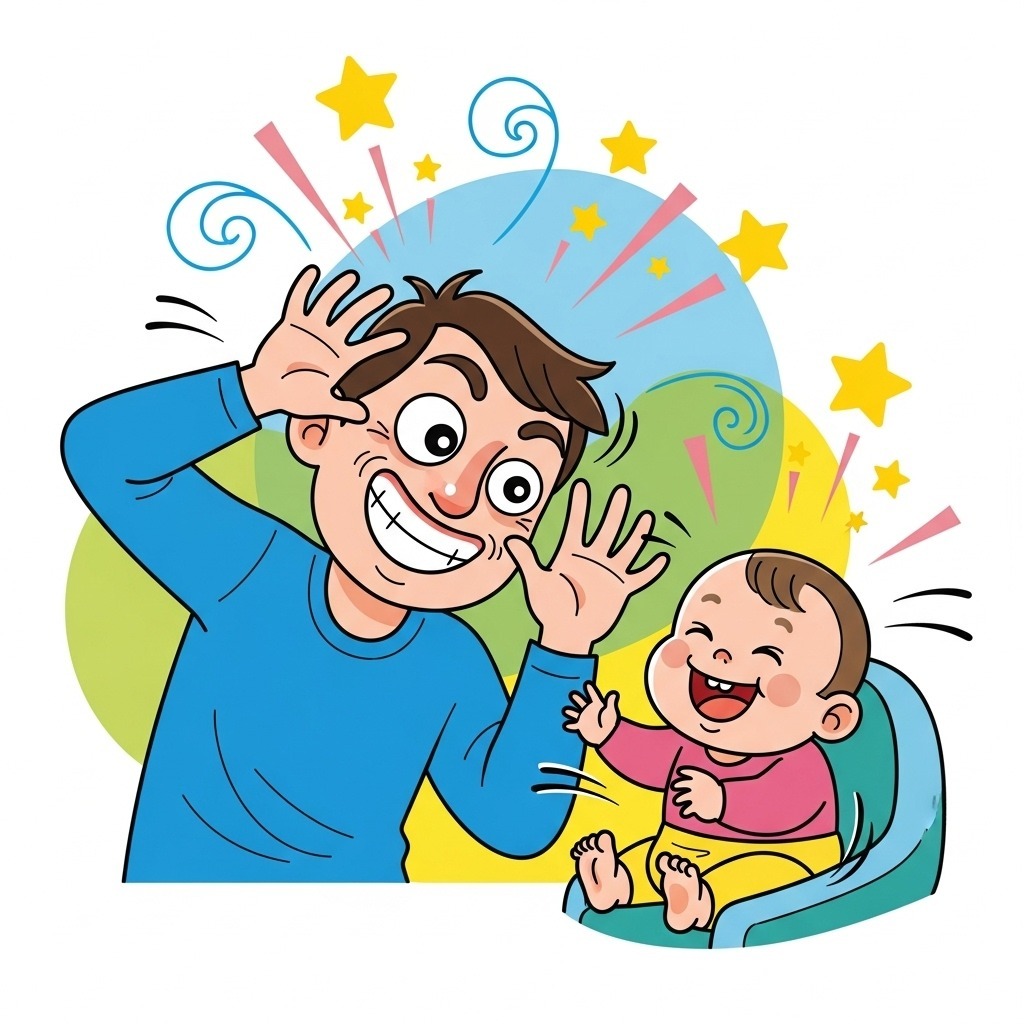
Be Dramatic and Exaggerate Everything
Babies respond to big expressions and animated voices. I felt completely ridiculous at first, but my daughter LOVED it when I’d:
- Open my eyes super wide
- Make my mouth into a huge O shape.
- Raise my eyebrows dramatically.
- Use a high-pitched, sing-song voice.
- Do big, sweeping hand gestures.
My husband would walk in on me making these insane faces at our daughter, and I’d just shrug. Whatever works, right?
Try Physical Play
Babies love movement and gentle physical play. Things that worked for us:
- Gentle bouncing on my knees
- “Flying” her through the air
- Raspberry kisses on her belly during diaper changes
- Tickling her feet and hands
- Dancing around the room with her
We also got this inflatable bouncer that she absolutely loved. The gentle bouncing motion, combined with my making silly faces at her, produced some of her biggest early smiles.
Play Peekaboo (Even Before They Fully Get It)
Peekaboo is magic. Even before babies fully understand object permanence, they respond to the surprise element. Cover your face with your hands, then reveal yourself with a big smile and a “Peekaboo!” The element of surprise triggers delight, which often leads to smiles.
Make Sure They’re Well-Rested and Fed
This is crucial and something I learned the hard way. A tired, hungry baby isn’t going to smile, no matter how many silly faces you make. I’d spend 20 minutes trying to get a smile from my overtired daughter, getting increasingly frustrated, before realizing she just needed a nap.
The best times for smile practice:
- Right after a good nap, when they’re alert but calm
- During or after feedings, when they’re content
- During bath time, if they enjoy it
- First thing in the morning (this was our golden hour)
Having easy-to-prep snacks ready for when they’re older helps too—these reusable snack containers made feeding times less stressful, which meant more happy baby time overall.
What Comes After Smiling
Just when you think baby smiles are the best thing ever, the development train keeps rolling. Smiling is just the beginning of your baby’s social and communication journey.
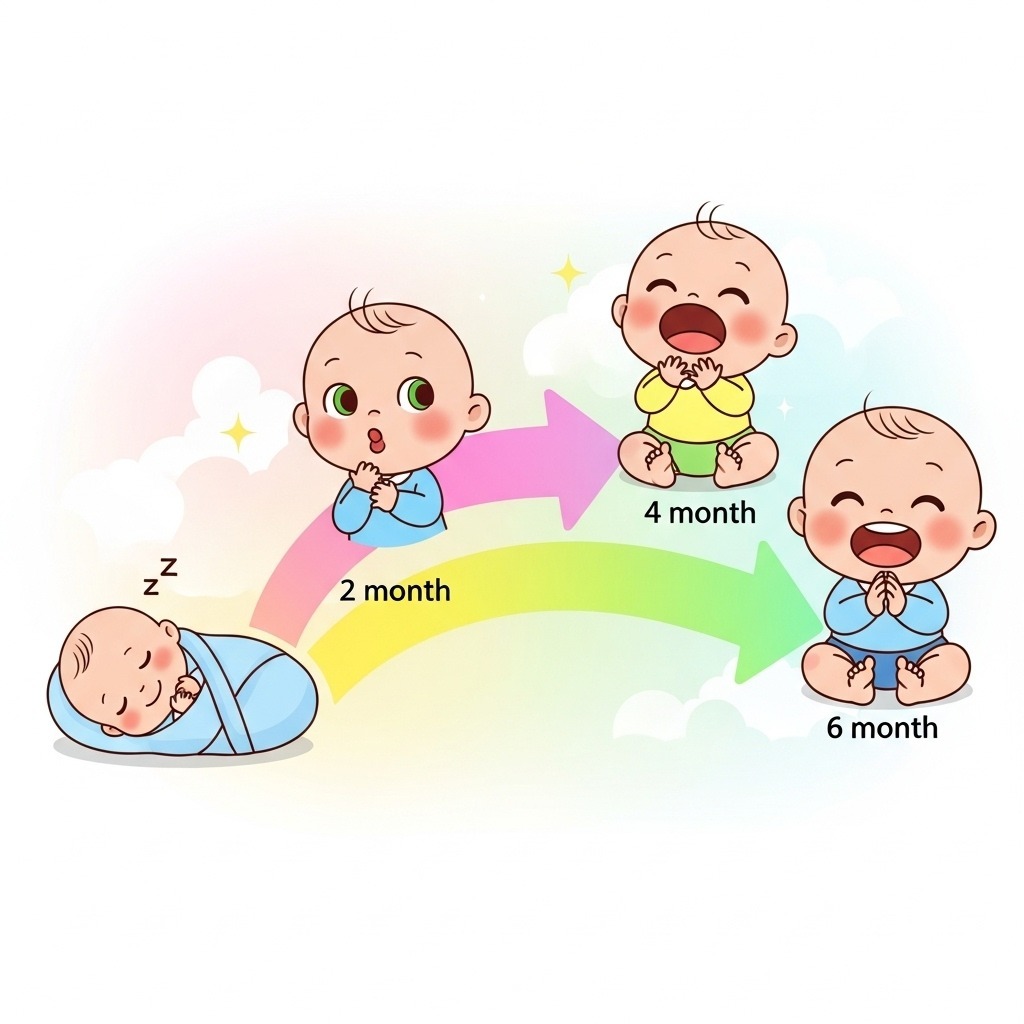
Cooing (Around 2-3 Months)
Right around the same time social smiles begin, you’ll start hearing coos. These are those sweet little “ooh” and “aah” sounds babies make when they’re happy. Cooing often happens alongside smiling, and it’s the earliest form of vocal communication. When my daughter started cooing back at me when I talked to her, I felt like we were having real conversations.
Laughing (Around 4-6 Months)
If smiles are wonderful, baby laughs are absolutely magical. Most babies start giggling and chuckling around 4 months old, though some take a bit longer. My daughter’s first real laugh came at 4.5 months when my husband pretended to sneeze really dramatically. That belly laugh was worth all the sleepless nights, I swear.
Things that make babies laugh:
- Silly sounds (especially raspberries and funny noises)
- Physical play (gentle tickling, flying)
- Unexpected movements
- Funny faces
- Watching siblings or pets do something amusing.
Babbling (Around 4-6 Months)
After cooing comes babbling—those repetitive consonant-vowel combinations like “bababa” or “dadada.” This happens around 4-6 months and shows increasing language development. Similar to how babies learn when they start talking, these early sounds are the building blocks of real words.
Emotional Range (6+ Months)
As your baby gets older, you’ll see more variety in their facial expressions. They’ll show surprise with raised eyebrows, frustration with furrowed brows, and excitement with their whole body. Smiling becomes just one part of a much richer emotional vocabulary.
The Mayo Clinic notes that this progression from smiling to cooing to laughing to babbling represents major leaps in your baby’s brain development, particularly in the areas responsible for social interaction and communication.
When to Worry (And When Not To)
This is the section I wish I’d read earlier because I spent way too much time worrying unnecessarily.
When NOT to Worry:
Your baby isn’t smiling at 6 weeks. Some babies take until 8-10 weeks or even 3 months to show consistent social smiles. Every baby develops at their own pace. If your baby was premature, remember to count from their due date, not their birth date.
Your baby seems serious. Just like adults, babies have different temperaments. Some are naturally more smiley and expressive, while others are more observant and serious. This doesn’t mean anything is wrong—it’s just their personality.
Your baby smiles more at strangers than at you. I know this stings (I’ve been there!), But it doesn’t mean your baby loves others more. Sometimes babies smile more at new faces simply because they’re interesting and novel. You see your baby all the time, so the surprise factor is gone.
Your baby didn’t smile at you first. Again, this hurt my feelings when it happened, but it’s meaningless. Whoever happens to be engaging with your baby at the right moment gets the smile. It’s not a reflection of attachment or preference.
When to Talk to Your Pediatrician:
No smiling by 3 months. If your baby still isn’t showing any social smiles by 3 months (or 3 months past their due date if they were premature), mention it to your pediatrician. It could be nothing, but it’s worth checking.
No eye contact. If your baby isn’t making eye contact with you by 3 months, this is more concerning than a lack of smiling. Eye contact is a crucial part of social development.
No response to voices or sounds. If your baby doesn’t turn toward your voice or react to loud noises, this might indicate a hearing issue that needs to be evaluated.
Loss of skills. If your baby was smiling and then stops, or if they seem to be losing other developmental skills they’d gained, contact your pediatrician right away.
Your gut says something’s wrong. You know your baby better than anyone. If you have a persistent feeling that something isn’t right, trust your instinct and bring it up with your doctor. It’s always better to ask and be reassured than to worry in silence.
The important thing to remember: autism and other developmental differences typically can’t be diagnosed in early infancy. A lack of smiling at 2 months doesn’t mean your baby has autism. These conditions are usually identified much later, around 18 months to 2 years old. Often, babies who aren’t smiling early just need a bit more time or might have a vision issue that’s easily correctable.
What I Wish I’d Known Sooner
Looking back now with my daughter happily chattering away as a toddler, here’s what I wish I could tell my anxious new-mom self:
Stop watching other babies. I tortured myself by comparing my daughter to my friend’s baby, who smiled at 5 weeks. It made me feel like a failure, like I wasn’t doing enough to make my baby happy. But they were just two different babies on two different timelines. Comparison truly is the thief of joy.
Put down the phone sometimes. I was so obsessed with capturing her first smile on camera that I almost missed actually experiencing it with my own eyes. Some moments are better lived than documented.
The waiting makes it sweeter. When that first real smile finally came, it was so worth the wait. If babies smiled from day one, we’d probably take it for granted. The anticipation and the buildup make that milestone even more special.
Every “first” feels important, and then there’s another one. I stressed so much about her first smile, her first laugh, her first word. But here’s the truth: these moments keep coming. There will always be another milestone to celebrate. Try to enjoy the journey instead of just focusing on the destination.
Your baby already loves you. Even before your baby can smile at you, they love you. They know your smell, your voice, your heartbeat. The smile is just them learning a new way to show you what’s already there. Just like how we help our kids learn various activities as they grow, smiling is just one of many ways they’ll learn to express themselves.
It gets even better. I thought baby smiles were the peak of parenthood, but then came the laughs, the first words, the hugs, the “I love yous. Each stage has its own magic.
If you’re still waiting for that first smile, hang in there. Keep smiling at your baby even when they don’t smile back. Keep talking to them, singing to them, making silly faces. One morning, probably when you least expect it, they’ll look at you and their whole face will light up with joy. And it will be absolutely worth every sleepless night, every worry, every moment of doubt.
Your baby’s smile is coming. And when it arrives, make sure you’re present enough to really see it—not just through a camera lens, but with your whole heart.
Frequently Asked Questions About When Babies Start Smiling
Q: Can a newborn smile at 1 week old?
Technically, yes, but it’s a reflex smile, not a social one. Newborns often smile during sleep or when they’re drowsy in the first few weeks of life. These reflex smiles are random and not in response to you or anything external—they’re just your baby’s face practicing expressions. True social smiles that happen in response to seeing you or hearing your voice typically don’t appear until around 6-8 weeks old. So if your 1-week-old “smiles” at you, enjoy the cuteness but know that the real, meaningful smiles are still a few weeks away.
Q: Why does my baby smile more at strangers than at me?
I know this feels personal (it definitely did for me!), but it’s actually totally normal and doesn’t mean your baby prefers others. Babies often smile more at new faces because they’re novel and interesting. You’re with your baby all the time, so they’re used to your face. Strangers provide new stimulation. Additionally, strangers often put in extra effort with big smiles and animated expressions to get a response. It’s also worth noting that by 8-9 months, this usually reverses completely when stranger anxiety kicks in, and your baby will only want you. So if you’re feeling hurt now, just wait—soon you’ll be the only one who gets genuine smiles!
Q: Do babies smile in their sleep because they’re dreaming?
We don’t actually know for sure! Sleep smiles are common during the newborn stage, especially during REM (rapid eye movement) sleep. Some researchers think babies might be processing experiences or random brain signals during these sleep smiles, but we can’t know what babies are dreaming about (if anything). What we do know is that sleep smiles are reflex smiles, not social ones. They’re not happening in response to anything external. My daughter smiled in her sleep constantly during her first month, and I liked to imagine she was having happy dreams, even though she was probably just flexing her facial muscles.
Q: How can I tell the difference between a reflex smile and a real smile?
Great question! Here are the key differences: Reflex smiles are brief (just a second or two), often happen during sleep or drowsiness, don’t involve eye contact, might look lopsided or like a grimace, and occur randomly without any trigger. Real social smiles last longer (several seconds), only happen when the baby is awake and alert, involve direct eye contact and full facial engagement, are symmetrical and involve the whole face (including eyes crinkling), and occur in response to something specific like your face, voice, or a funny sound. Once you see a real social smile, the difference becomes obvious. Social smiles feel like communication—like your baby is telling you they’re happy to see you.
Q: Should I be worried if my 2-month-old isn’t smiling yet?
Not necessarily. While many babies show social smiles by 6-8 weeks, the normal range extends to 3 months. Some babies just need a bit more time, especially if they were born prematurely (use their due date to calculate milestones, not their birth date). However, if your baby still isn’t showing any social smiles by 3 months old, it’s worth mentioning to your pediatrician. Also, pay attention to other forms of engagement: Is your baby making eye contact? Do they turn toward your voice? Do they react to loud sounds? If they’re engaging with you in other ways, they’re probably fine and just taking their time with smiling. If they’re not engaging at all—no eye contact, no response to voices, no reaction to faces—that’s when you should definitely talk to your doctor. They might check vision and hearing to rule out any issues.
Waiting for your baby’s first smile can feel like forever, but it’s coming, mama. One day soon, your baby will look at you with pure recognition and joy, and everything will suddenly feel worth it. Until then, keep smiling at them anyway—even if they don’t smile back yet. They’re watching, learning, and storing up all that love for the moment when they can finally smile back at you.