
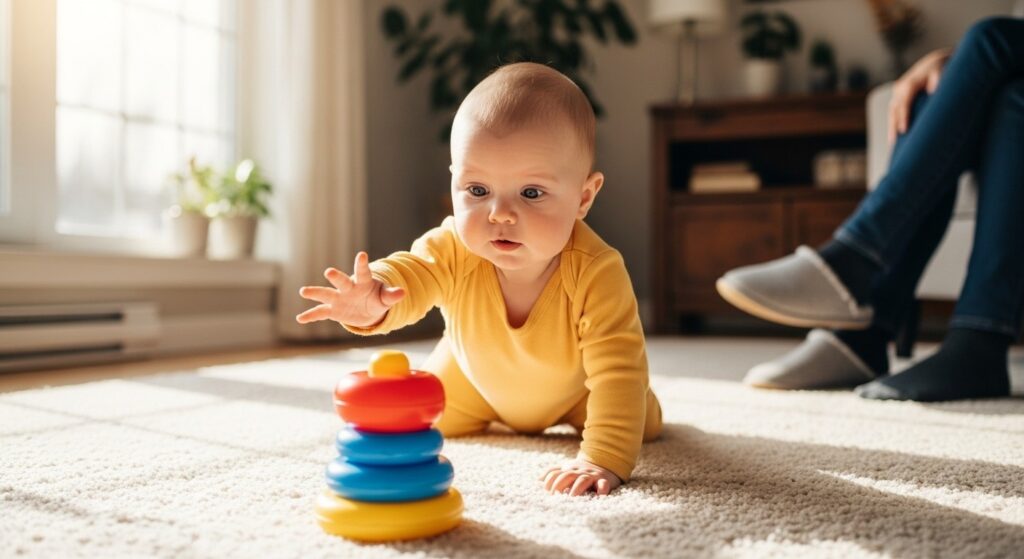
I’ll never forget the morning I found my 8-month-old daughter halfway across the living room. Not crawling forward like I’d been expecting and waiting for. Nope. She was scooting backward, getting farther and farther from the toy she was trying to reach, looking increasingly frustrated with every push.
I panicked for exactly three seconds, wondering if something was wrong. Then I called my pediatrician, who laughed (kindly) and told me backward crawling is completely normal. Some babies do it for weeks before they figure out how to go forward.
That moment taught me something important: when do babies crawl isn’t just about the age—it’s about understanding that every baby has their own timeline, their own style, and their own way of figuring out this whole mobility thing. And honestly? Most of us worry way more than we need to.
The Real Answer About When Babies Crawl
Here’s what you actually need to know: most babies start crawling somewhere between 7 and 10 months old. But—and this is important—anywhere from 6 to 12 months is completely normal.
My first baby crawled at 7 months. My second at 10 months. My friend’s baby? Skipped crawling entirely and went straight to pulling up and walking at 11 months. All three are perfectly healthy, developmentally on-track kids now.
According to the Mayo Clinic, crawling is a motor milestone that varies significantly from baby to baby. Some hit it early, some hit it late, and some find alternative ways to get around that work just as well.
The range is wide because babies develop at different rates based on lots of factors: their temperament, how much floor time they get, whether they have older siblings to watch and mimic, their body type, and just their own individual developmental timeline.
If your baby isn’t crawling by their first birthday but is showing other signs of development—pulling to stand, cruising along furniture, scooting, rolling—your pediatrician probably won’t be concerned. But if you are worried, that’s what well-baby checks are for. Trust your gut and ask.
Signs Your Baby Is Getting Ready to Crawl
Before my kids crawled, they showed telltale signs that mobility was coming. I just didn’t know what to look for with my first baby.
Here’s what to watch for:
Rocking on hands and knees. This is the big one. Your baby gets into a crawling position and rocks back and forth like they’re revving an engine but not going anywhere. It’s adorable and means crawling is probably days or weeks away.
Pushing themselves backward. Like my daughter, many babies figure out backward movement first. The mechanics make more sense to their developing brains and bodies.
Rolling everywhere. If your baby is using rolling as their primary mode of transportation, they’re working on the core strength and coordination needed for crawling.
Sitting without support. Once babies can sit up independently (usually around 6-7 months), they have the trunk strength needed to start experimenting with hands-and-knees positions.
Pivoting in circles. When your baby is on their tummy and turns in a full circle to look at different things, they’re developing the coordination that will soon become crawling.
Army crawling or commando crawling. Some babies drag themselves along on their bellies, pulling with their arms. This counts as crawling, even if it doesn’t look like the hands-and-knees version you’re expecting.

One thing I wish I’d known with my first: these signs don’t all happen at once or in any particular order. And some babies show zero signs and then suddenly just start crawling one day. Babies are weird like that.
The Different Ways Babies Crawl (Yes, There’s More Than One)
This blew my mind when I learned it: there’s no single “right” way to crawl. The American Academy of Pediatrics recognizes at least six different crawling styles, and babies often invent their own variations.
Classic crawl. This is what everyone pictures—a baby on hands and knees, moving one hand forward with the opposite knee. It’s a textbook, but actually not the most common starting method.
Army crawl or belly crawl. Baby lies flat on their tummy and pulls themselves forward with their arms, legs dragging behind. My son did this for two months before switching to hands and knees. He looked like he was going through military boot camp.
Bear crawl. Baby walks on hands and feet with their bottom in the air and legs straight. It looks like a yoga pose and is surprisingly efficient.
Bottom scoot. Baby sits on their bottom and uses their arms and sometimes legs to scoot along the floor. This works best on hard floors and was my second baby’s preferred method for a few weeks.
Crab crawl. Baby propels themselves sideways or backward with one hand and bent knees. It looks strange, but it gets them where they want to go.
Rolling crawl. Why crawl when you can roll? Some babies perfect the art of rolling from place to place and stick with it for months.
The style doesn’t matter. What matters is that your baby is figuring out how to move independently and coordinate both sides of their body.
For babies who love being active, these inflatable dome rocker bouncers are perfect for building the core strength and balance needed for crawling—my kids used theirs constantly during this stage.
How to Encourage Crawling (Without Driving Yourself Crazy)
You can’t force your baby to crawl, but you can create an environment that makes them want to try. Here’s what actually worked for me:
Give Lots of Tummy Time
I know, I know—some babies hate tummy time. Mine screamed through it for months. But tummy time builds the shoulder, arm, back, and neck strength babies need for crawling.
Start small. Even 2-3 minutes several times a day adds up. Get down on the floor with them. Put toys just in front of their face. Sing songs. Make it as fun as possible.
If your baby really hates it, try doing tummy time on your chest instead of the floor, or draped over a nursing pillow. Any tummy time counts.
Create a Safe, Open Space
Clear out a section of your living room and let your baby have supervised floor time. No bouncy seat, no exersaucer, no containment devices—just baby, floor, and freedom to explore.
Babies won’t try to move if they’re always strapped into something. They need unrestricted time to experiment with their bodies and figure out how to control them.
Place Toys Just Out of Reach
This sounds mean, but it’s brilliant. Put your baby’s favorite toy about two feet away from them. Close enough that they can see it and want it, far enough that they have to work to get there.
When they start moving toward it—even if it’s just a lunge or a roll—celebrate like they just won an Olympic medal. Encouragement matters.
Let Them See Other Babies and Kids Moving
My second baby started crawling earlier than my first, and I’m convinced it’s because she watched her older brother zoom around the house. Babies learn by imitation.
If you don’t have other kids at home, playdates with crawling babies can be incredibly motivating. My friend’s daughter literally watched another baby crawl at the library and tried it herself that same afternoon.
Don’t Stress About It
This is the hardest tip but the most important one. Your anxiety transfers to your baby. If you’re constantly trying to “make” them crawl, it becomes stressful for both of you.
Crawling will happen when it happens. Your baby is not behind. They’re not delayed. They’re on their own perfect timeline.
For keeping babies entertained during floor time, these developmental milestone books have been fantastic for understanding what to expect and when, which really helped ease my anxiety about whether my kids were “on track.”
What If Your Baby Isn’t Crawling Yet?
My daughter didn’t crawl until 10 months. My sister’s baby didn’t crawl until 11 months. Both are completely normal.
Before you worry, ask yourself these questions:
Is your baby showing any form of mobility? Rolling, scooting, army crawling, pulling to stand—these all count. The goal is movement, not a specific type of movement.
Is your baby meeting other milestones? If they’re babbling, making eye contact, responding to their name, picking up objects, and generally engaged with the world, one delayed milestone usually isn’t a concern.
Are you giving them enough floor time? Babies who spend most of their day in swings, bouncers, or being carried don’t have as much opportunity to practice moving. Make sure they’re getting plenty of supervised free play on the floor.
Could there be a physical reason? If your baby seems uncomfortable during tummy time, arches their back constantly, or shows resistance to being on their stomach, mention it to your pediatrician. Sometimes there are treatable issues like tongue tie or torticollis that can affect development.
For more insights into developmental timelines, check out our article on when kids start walking, which is the natural next milestone after crawling.
When you should definitely call your pediatrician:
- Your baby isn’t showing any interest in moving or bearing weight on their legs by 12 months
- Your baby isn’t using both sides of their body equally (drags one leg, favors one arm)
- Your baby lost skills they previously had
- You just have a gut feeling that something isn’t right.
Trust your instincts. You know your baby better than anyone.
Babyproofing for a Crawling Baby
The day my first baby started crawling, I realized how completely unprepared I was. He made a beeline for the dog’s water bowl, dunked his entire face in it, and then headed straight for the fireplace.
Here’s what you need to do before your baby starts moving:
Secure Heavy Furniture
Babies pull up on everything. Dressers, bookshelves, TV stands—all of it can tip over. Anchor heavy furniture to the wall with furniture straps. This is non-negotiable.
Install Safety Gates
Put gates at the top and bottom of all staircases. Even if your baby can’t climb stairs yet, they will try. And they’ll figure it out faster than you expect.
Cover Outlets and Hide Cords
Get outlet covers for every single outlet. Tie up blind cords and curtain cords where babies can’t reach them. Hide electrical cords behind furniture or use cord covers.
Lock Cabinets
Install child safety locks on cabinets containing cleaning products, medicines, sharp objects, or anything else hazardous. Babies are drawn to cabinets like magnets.
Pad Sharp Corners
Coffee tables, fireplace hearths, and low shelves—put corner guards and edge bumpers on anything your baby might hit their head on as they’re learning to navigate.
Get Down on Baby’s Level
Literally crawl around your living areas and see what’s accessible from that height. You’ll be shocked at what you missed standing up.
The crawling stage is when babyproofing becomes absolutely critical. Before this, your baby couldn’t get to the most dangerous things. Now they can, and they’re fast.
For organizing small toys and objects that become choking hazards, these reusable snack containers have been lifesavers for keeping small pieces up high and organized.
What Comes After Crawling?
Once my babies started crawling, everything accelerated. Within weeks, they were pulling to stand. Within a month or two, they were cruising along furniture. And before I knew it, they were walking.
Crawling usually doesn’t last long—maybe a few months at most. Some babies crawl for only a few weeks before moving on to standing and walking.
Here’s the typical progression:
Crawling (7-10 months typically). Baby masters moving across the floor using whatever crawling style works for them.
Pulling to stand (8-12 months). Baby uses furniture, your legs, the dog, anything sturdy to pull themselves up to standing.
Cruising (9-13 months). Baby walks sideways along furniture while holding on for support.
Standing independently (10-14 months). Baby can stand without holding onto anything, usually for just a few seconds at first.
First steps (9-15 months). Baby takes those magical first independent steps without support.
Walking (12-18 months). Baby masters walking and becomes increasingly steady on their feet.
Every baby moves through these stages at their own pace. My friend’s baby was walking confidently at 10 months. Mine weren’t walking until 13 and 14 months. All normal.
For more on related developmental milestones, our guide on when kids start talking covers another major first-year milestone that often overlaps with crawling and walking.
The Emotional Side of the Crawling Milestone
Can we talk about the feelings for a minute? Watching your baby become mobile is exciting and terrifying in equal measure.
Exciting because: independence! They’re growing up! They’re hitting milestones! They can entertain themselves for 10 whole minutes while they crawl after the cat!
Terrifying because: independence. They’re growing up too fast. They’re no longer your immobile baby who stays where you put them. They can get into everything, everywhere, all the time.
I cried the first time each of my babies crawled. Happy tears, proud tears, and also sad tears because it meant my tiny baby phase was officially over.
It’s okay to feel conflicted about milestones. You can be proud and sad at the same time. You can celebrate their growth while mourning the stage that’s ending.
I found it helpful to take lots of videos and photos during the crawling stage. It goes by so fast, and looking back at those shaky first crawls always makes me smile now.
Also, remember that mobility means mess. Crawling babies get into everything. Your house will be chaos. That’s normal and temporary. It doesn’t mean you’re failing at organization or parenting—it means you have a healthy, curious, mobile baby exploring their world.
To keep my sanity during this chaotic stage, these parenting books gave me so much perspective and reassurance that the mess and mayhem are temporary phases, not permanent states.
Common Crawling Questions From Moms Like You
Do all babies crawl before walking?
Nope. About 20% of babies skip crawling entirely and go straight to pulling up, cruising, and walking. This is totally normal and doesn’t indicate any developmental issues. Some babies just find their own path to mobility that doesn’t include traditional crawling.
Is it bad if my baby skips crawling?
Not at all. Old theories suggested crawling was essential for brain development and coordination, but research has debunked this. As long as your baby is finding some way to move around and explore—whether it’s scooting, rolling, or walking—they’re developing just fine. The goal is mobility, not a specific type of movement.
Why is my baby crawling backwards?
Backward crawling is super common and happens because babies figure out how to push with their arms before they understand how to pull themselves forward. It’s frustrating for them (and hilarious for us), but most babies work out forward crawling within a few weeks. Just keep encouraging them, and they’ll figure it out.
How can I make my baby crawl faster?
You can’t force developmental readiness, but you can create opportunities. Lots of supervised floor time, placing interesting toys just out of reach, minimizing time in containers like bouncers and swings, and making sure they’re getting enough tummy time all help. But ultimately, your baby will crawl when they’re developmentally ready, not before.
At what age is it too late for crawling?
If your baby isn’t showing any form of independent mobility (crawling, scooting, rolling, pulling to stand) by 12 months, it’s worth discussing with your pediatrician. However, remember that some babies go straight to walking without crawling, which can happen between 9-15 months. The key is that they should be showing some form of movement and progress toward independence by their first birthday.
Here’s what I wish someone had told me with my first baby: there’s no prize for early crawling. Your baby hitting milestones early doesn’t make them smarter, more advanced, or destined for greatness. And hitting milestones later doesn’t mean anything negative either.
My daughter, who crawled at 10 months, is now a confident, athletic kid who loves sports. My son, who crawled at 7 months, is more cautious and careful with physical activities. The age they crawled had zero correlation with who they became.
What mattered was that I stayed present wherever they were in their development. I celebrated their attempts, not just their successes. I gave them safe space to explore and make mistakes. And I stopped comparing them to other babies.
The crawling stage is a beautiful, chaotic, exhausting, exciting time. Your baby is becoming a little person who can explore the world on their own terms. They’re learning about cause and effect, problem-solving, spatial awareness, and persistence.
Every baby will get there in their own time and in their own way. Some will crawl early and often. Some will take their time and figure it out later. Some will find alternative methods that work better for them.
Your job isn’t to force the timeline. It’s to provide opportunities, ensure safety, offer encouragement, and trust that your baby’s body knows what it’s doing.
Take the videos. Laugh at the backward crawling and the funny styles. Babyproof your house before you think you need to. And enjoy this fleeting stage before they’re running circles around you—which, trust me, happens about five minutes after they master crawling.
`