
Last Thursday evening, I found myself scrolling through my phone while my six-year-old daughter tried to show me her LEGO creation for the third time. “Mom, look!” she kept saying, but I was half-listening, nodding absently while mentally planning tomorrow’s lunches and wondering if I’d responded to that work email. When she finally walked away with slumped shoulders, I felt that familiar pang of mom guilt. I was physically present but completely checked out, and she knew it.
That moment made me realize something important: Knowing how to engage with kids isn’t about having unlimited energy or endless patience. It’s about finding small, meaningful ways to connect even when you’re exhausted, distracted, or have zero creative ideas left. After that wake-up call, I started researching and testing different engagement strategies that actually fit into our chaotic real life—not the Pinterest-perfect version.
What I discovered changed our entire family dynamic. These aren’t elaborate activities that require hours of preparation or a perfectly clean house. They’re simple, practical ways to genuinely connect with your kids that work even when you’re running on fumes.

Why Engagement Feels So Hard (And It’s Not Your Fault)
Before I share what worked, let’s talk about why learning how to engage with kids feels so impossibly difficult sometimes. Between work demands, household responsibilities, mental load, and just basic survival mode, actually connecting with our children often falls to the bottom of the priority list. We’re physically present but mentally elsewhere, and kids can sense that immediately.
Quality matters more than quantity when it comes to parent-child interaction. But here’s what nobody tells you: Quality engagement doesn’t mean elaborate activities or undivided attention for hours. It means being fully present for small moments throughout the day—and that’s actually achievable even for exhausted parents.
Children who experience regular, meaningful engagement with their parents develop stronger emotional regulation, better social skills, and higher self-esteem. But “meaningful engagement” can be as simple as five minutes of truly focused attention where you follow your child’s lead and show genuine interest in what they’re saying or doing.
The guilt we feel about not engaging enough? That’s often because we’re comparing ourselves to an impossible standard. You don’t need to be the mom who organizes elaborate craft sessions every afternoon. You just need to find your own ways to connect that feel authentic and sustainable.
Let Your Child Lead the Play (This Was a Game-Changer)
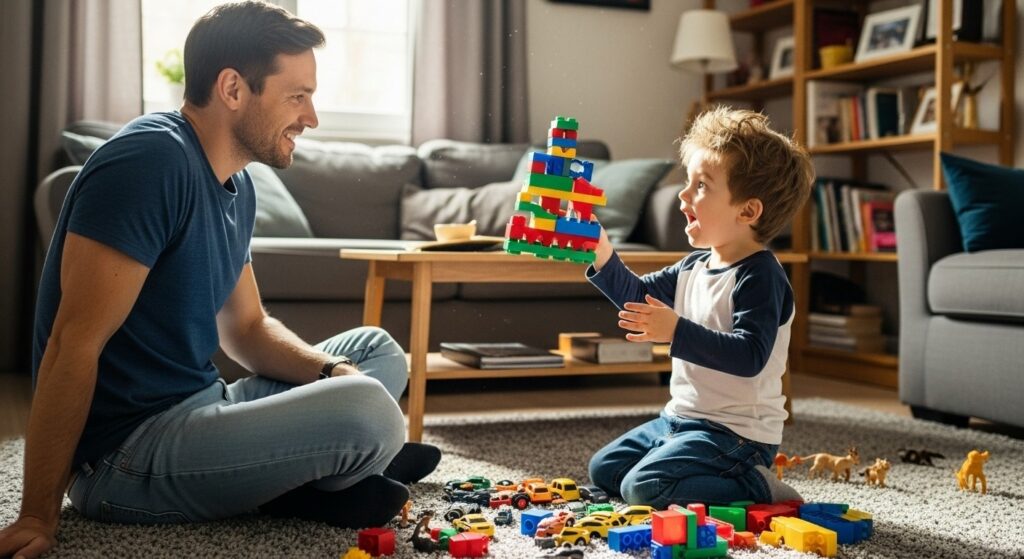
The first tip on how to engage with kids that completely transformed our relationship was simply letting my daughter take the lead during playtime. I used to direct everything—suggesting what we should build, how the game should go, what colors to use. No wonder she seemed disinterested. I wasn’t engaging with her; I was managing her.
Now, when we play, I ask, “What should we do?” and then follow her imagination wherever it goes. Sometimes we’re dinosaurs having a tea party. Sometimes we’re astronauts who also happen to be princesses. It makes zero logical sense to my adult brain, but it doesn’t need to. The point is that she’s driving the play, and I’m just along for the ride, showing genuine interest in her ideas.
This approach works because kids feel valued when adults take their interests seriously. When you let them lead, you’re communicating that their ideas matter, their imagination is important, and spending time in their world is something you want to do—not something you’re enduring.
The bonus? It requires way less energy from you. Instead of coming up with creative activities and managing all the details, you’re just responding to what your child initiates. Some days, we “cook” elaborate pretend meals in her play kitchen. Other days, we simply sort her toy animals by color because that’s what interests her. Both count as meaningful engagement.
If you’re looking for activities that naturally encourage child-led play, having board games for kids on hand provides structure while still allowing children to make choices and express themselves during gameplay.
Use Everyday Moments as Connection Opportunities
One of the best lessons on how to engage with kids came from realizing I was waiting for “the right time” instead of using the dozens of small opportunities already built into our day. Engagement doesn’t require dedicated playtime—it can happen during morning routines, meal prep, car rides, and bedtime.
Now I narrate what I’m doing while cooking dinner: “I’m chopping these carrots into little pieces. Do you think they’ll turn soft or stay crunchy when we cook them?” This invites conversation and teaches without feeling like a lesson. My son loves guessing what will happen, and suddenly, he’s engaged in a kitchen science experiment instead of bothering his sister in the next room.
Car rides became question time instead of screen time. We play games like “What made you happy today?” or “If you could have any superpower, what would it be and why?” These conversations give me insight into his thinking and feelings that I wouldn’t get otherwise. Some of our best talks happen during the 10-minute drive to school.
Bath time transformed from a chore into connection time when I started sitting on the bathroom floor for five minutes instead of rushing off to fold laundry. Those five minutes where I’m actually present—asking about his day, playing a quick game with bath toys, or just listening to whatever story he’s creating—matter more than the 30 minutes I used to spend half-engaged while multitasking.
Bedtime routines are prime engagement time if you slow down enough to use them. Instead of rushing through books and tucking in quickly, we do story time where I ask questions about the characters, or we make up our own stories together. Creating consistent rituals strengthens parent-child bonds.
The key is being mentally present during these routine moments. Put your phone in another room. Make eye contact. Listen without planning your response. These micro-connections throughout the day add up to significant engagement. For more ideas on maximizing everyday moments, explore our guide on activities to do with kids.
Ask Better Questions (And Actually Listen to the Answers)
Learning how to engage with kids improved dramatically when I changed how I communicated with them. Instead of “How was school?” (which always got “Fine” as a response), I started asking specific, open-ended questions that required more than one-word answers.
“What made you laugh today?” “Who did you sit with at lunch?” “What was the hardest part of your day?” “If you could change one thing about today, what would it be?” These questions show that I’m genuinely curious about their experiences and inner lives, not just checking a box.
But here’s the crucial part: Actually listen to the answers without multitasking, interrupting, or immediately trying to fix problems. When my daughter tells me about a conflict with a friend, my instinct is to jump in with solutions. But I’ve learned to just listen first, reflect back what I hear (“That sounds really frustrating”), and ask “What do you think you could do?” before offering my own ideas.
Active listening means putting down whatever you’re holding, making eye contact, and giving your full attention. It’s hard! My brain wants to keep meal-prepping or folding laundry while we talk. But kids know the difference between surface-level “mm-hmm” responses and genuine engagement.
I also started sharing more about my own day in age-appropriate ways. “I made a mistake at work today and had to figure out how to fix it,” or “I had a disagreement with Aunt Sarah, but we talked it out.” This model that everyone faces challenges, and I trust them with my experiences, too. Engagement is a two-way street.
For kids who struggle with direct questions, try incorporating conversation starters for kids during meal times to make dialogue feel more natural and fun.

Create Screen-Free Connection Time (Even Just 15 Minutes)
This tip on how to engage with kids was the hardest to implement, but made the biggest difference. I’m not going to pretend we’re a screen-free family—we’re not. But establishing clear screen-free times created space for actual engagement that wasn’t happening when devices were always available.
We now have a rule: No screens (for anyone, including me) from dinner time until after bedtime routine. That’s roughly 6:00-8:00 PM. Those two hours used to involve me cooking while the kids watched TV, then everyone on separate devices after eating. Now those hours are when real connection happens.
Some evenings we play simple games—card games, board games, or active games like hide-and-seek. We keep a basket of board games easily accessible in the living room, and having options ready makes it easy to grab something when someone says, “I’m bored.” On days when energy is low, we opt for easier games like Candy Land Bluey Edition that even our youngest can play.
Other evenings we just hang out together. Kids play while I sit nearby reading or doing quiet work—but I’m available and present. When they want to show me something or ask a question, I stop and engage. This “parallel play”, where everyone is in the same space doing their own thing but available to each other, counts as quality time too.
The difference is remarkable. Arguments decreased. Kids stopped constantly asking for screens because they weren’t thinking about them. Conversation increased. And honestly, I started to enjoy this time instead of viewing it as something to survive until bedtime.
If giving up all screens feels impossible, start smaller. Pick one 30-minute window where everyone puts devices away. Morning breakfast, right after school, or bathtime—whatever works for your family. The consistency matters more than the length.
Engage Through Physical Activity and Movement
One unexpected lesson in how to engage with kids was discovering that my children connect better through movement than conversation. Some kids (and adults) are just wired that way. Sitting still and talking doesn’t come naturally, but playing an active game opens them up.
We started doing “active time” before homework each day. Sometimes it’s shooting baskets in the driveway while chatting. Sometimes it’s a quick dance party to three songs in the living room. Sometimes it’s a walk around the block with the dog. The physical activity serves two purposes: It burns off energy that would otherwise prevent focus, and it creates a natural environment for connection without the pressure of face-to-face conversation.
My son talks more openly when we’re doing something physical side-by-side than when we’re sitting across from each other. I’ve learned to use this. Our best conversations happen while tossing a ball back and forth or during walks. There’s something about the reduced eye contact and divided attention that makes hard topics easier to discuss.
For younger kids, rough-and-tumble play builds connection through physical interaction. Wrestling (safely), tickle fights, piggyback rides, and chase games create laughter and bonding. The physical closeness releases oxytocin, the bonding hormone, strengthening your relationship without requiring deep conversation.
Weather permitting, we try to spend at least 15 minutes outside together daily. Having engaging outdoor equipment makes this easier. A bean bag toss game in the backyard creates opportunities for friendly competition and interaction. Even something simple like kicking a ball around provides movement-based connection time. For more ideas, check out our collection of outdoor games for kids.

Read Together and Tell Stories
One of the simplest ways to learn how to engage with kids is through books and storytelling. This works for all ages, not just young children. Even my ten-year-old still loves our evening reading time, where we read chapter books together.
The key is making it interactive instead of just reading words on a page. I ask questions: “What do you think will happen next?” “How would you feel if you were this character?” “What would you do differently?” This transforms passive listening into active engagement and teaches critical thinking skills in the process.
For younger children, let them participate in the reading. They can point to pictures, make sound effects, turn pages, or “read” familiar parts along with you. Reading together builds language skills while creating a cozy bonding experience.
We also make up our own stories. Sometimes I start a story and stop mid-sentence for my child to continue. We go back and forth, each adding to the narrative. These stories get ridiculous and hilarious, and that’s the point. The laughter and creativity strengthen our connection.
Telling family stories is another powerful engagement tool. Kids love hearing stories about when they were babies, when you were a kid, or about their grandparents. These stories give them a sense of family history and identity while creating intimate conversation. “Tell me about when I was born” is a frequent bedtime request in our house.
Making up jokes and riddles together exercises creativity while building connection. Start with simple formats: “Knock knock” jokes or “Why did the [animal] cross the road?” Then let kids create their own. They’re usually terrible and make no sense, but the shared laughter is what matters. If your kids enjoy this kind of wordplay, they might also love our collection of jokes for kids that can spark even more shared giggles.
Don’t underestimate the power of having a variety of engaging reading materials available. Kids’ activity books and workbooks provide interactive experiences that combine reading with hands-on engagement, making them perfect for restless kids who struggle with traditional storybooks.
Get Creative Together (No Art Degree Required)
When people talk about how to engage with kids through creativity, it often sounds intimidating if you’re not naturally crafty. But creative engagement doesn’t require Pinterest-worthy results or expensive supplies. It’s about the process and the time spent together, not the finished product.
We keep a “creativity box” stocked with basic supplies: paper, crayons, markers, stickers, glue sticks, pipe cleaners, and whatever random craft items we accumulate. When boredom strikes or screens have been on too long, we dump out the box and just create. No plan, no project in mind—just making whatever feels right.
Sometimes we draw pictures of our day or our feelings. Sometimes we make cards for family members. Sometimes we just cut up paper and glue it randomly. The point isn’t creating something beautiful; it’s spending time together experimenting and talking while we create.
Cooking and baking together is a creative engagement that results in something delicious. Kids can help measure, pour, stir, and taste-test. We’ve made everything from simple pasta to elaborate birthday cakes together. The bonus is that cooking teaches math, following directions, and patience, while creating opportunities for conversation and teamwork.
My kids love it when I let them experiment in the kitchen with supervision. “What do you think would happen if we added cinnamon to this?” “Should we make these cookies round or square?” Giving them choices and creative control within safe boundaries makes them feel valued and engaged. We’ve created some of our best memories (and a few disasters) through kitchen adventures together. Having kids bake and cook in sets specifically designed for children makes them feel more capable and invested in the process.
Music and dance are creative outlets that require zero supplies. We have impromptu dance parties, make up silly songs, or just listen to music together. I’ve learned songs my kids love (even though I can’t stand them) because singing along together is a bonding experience. When they see me embracing their interests even when it’s not my preference, it communicates that they matter more than my comfort.
Having a well-stocked supply of kids’ craft supplies readily available removes the barrier of “we don’t have what we need,” making it easier to dive into creative projects on a whim. When everything is organized and accessible, engagement happens more naturally.

Build Connection Through Routine and Rituals
An underrated aspect of how to engage with kids is establishing consistent rituals that create predictable connection points throughout your day and week. These don’t have to be elaborate—small, repeated rituals provide kids with security and create dedicated engagement time.
We have a “daily share time” during dinner where everyone shares their highs and lows from the day. This simple ritual creates space for everyone to feel heard and provides insight into each other’s lives. Some evenings are deep and meaningful; others are silly and surface-level. Both are valuable.
Weekend breakfast together became our Saturday morning ritual. We make pancakes or waffles, eat without rushing, and plan our day together. This unhurried meal creates connection time that’s harder to find during busy weekday mornings. Everyone helps cook, set the table, and clean up—it’s a team effort that strengthens our sense of family.
Bedtime rituals provide consistent one-on-one time. I tuck in each child separately, spending 5-10 minutes just with them. We talk about their day, I ask if anything is worrying them, and we might read or pray together, depending on your family’s practices. This dedicated individual time makes each child feel seen and valued.
We also have “special time” once a week, where each child gets 30 minutes of one-on-one time with a parent, doing whatever they choose. Sometimes it’s playing a game, sometimes it’s baking cookies, sometimes it’s just walking to the park together. The activity matters less than the undivided attention.
Family game night happens every Sunday evening in our house. We take turns choosing the game, make popcorn, and commit to being fully present—no phones, no interruptions. This reliable weekly ritual gives us all something to look forward to and creates shared experiences we reference throughout the week.
The power of rituals is that they happen whether you feel particularly engaged or not. On days when you’re exhausted and tapped out and have nothing left to give, the ritual still happens because it’s just what you do. The consistency itself communicates love and commitment. To support different aspects of child development, understanding what kids learn in kindergarten can help you incorporate age-appropriate learning into your engagement rituals.
When Engagement Feels Impossible (Real Talk)
Let me be honest about how to engage with kids when you genuinely have nothing left to give. Some days, full engagement isn’t happening. You’re sick, overwhelmed, tapped out, emotionally depleted, or dealing with your own struggles. And that’s okay. Perfect engagement every day isn’t the goal—consistent effort over time is what matters.
On my worst days, I do “minimum viable engagement”—the bare minimum that maintains connection. That might look like sitting in the same room while kids play, responding when they talk to me, but not initiating activities. It might be an extra-long hug and some physical affection instead of elaborate playtime. It might be letting them watch TV while I rest, but pausing occasionally to ask what’s happening in the show.
I’ve learned to tell my kids when I’m struggling in age-appropriate ways: “Mommy is very tired today, so I need some quiet time. But I still love you and want to spend time together. How about we read books quietly instead of playing chase?” This honesty models that everyone has limits and teaches them to respect boundaries while maintaining connection.
Parallel play is underrated. You don’t always have to be actively playing with your kids to be engaged. Sometimes I sit nearby with my own activity (reading, craft project, or even scrolling my phone) while they play. But I’m available—I look up when they want to show me something, I respond to questions, I’m emotionally present even if not physically interactive.
Ask for help when you need it. Can your partner take the kids for an hour so you can recharge? Can you trade babysitting with another parent? Can you do a screen afternoon so you can rest? Taking care of yourself IS taking care of your kids, because engaged parenting requires a parent who has something to give.
And honestly? Some days, engagement just means keeping everyone alive, fed, and reasonably safe. Those days happen. They don’t make you a bad parent. Tomorrow is a fresh start, and kids are remarkably resilient and forgiving when we show up consistently over time, even imperfectly.
Frequently Asked Questions About Engaging With Kids
How much time should I spend engaging with my kids each day?
Quality matters more than quantity. Research suggests that 15-30 minutes of fully engaged, child-led, uninterrupted time per day is more valuable than hours of half-engaged interaction where you’re multitasking or mentally elsewhere. That said, multiple shorter engagement sessions throughout the day—during meals, routines, car rides—add up significantly. Don’t aim for perfection; aim for consistent presence. Some days you’ll have more to give, others less, and both are normal.
What if my child doesn’t want to engage with me?
This is common, especially with older kids or during developmental phases where independence is the goal. Don’t force it or take it personally. Keep offering low-pressure opportunities for connection: “I’m making cookies if you want to help,” or “Want to come with me to walk the dog?” Some kids engage better through parallel activities (doing separate things in the same space) than face-to-face interaction. Also, examine whether previous interactions felt controlling—kids disengage when they feel managed rather than genuinely connected with. Let them lead sometimes and see if that changes the dynamic.
How do I engage with multiple kids at different ages?
This is challenging! A mix of individual time and group activities works best. Schedule a brief one-on-one time with each child where they get your undivided attention, doing something they choose. For group engagement, pick activities everyone can participate in at their level—cooking together, family game night with age-appropriate games, outdoor play, or creative projects where each child contributes according to ability. Sometimes older kids enjoy “teaching” younger siblings an activity, which builds a connection between them while giving you a moment to breathe.
What if I’m naturally introverted and find constant engagement exhausting?
You’re not alone—many parents are introverts who need alone time to recharge. Build in breaks by choosing quieter engagement activities that don’t deplete your energy: reading together, parallel play, puzzles, quiet creative projects, or audiobooks you listen to as a family. Establish a quiet time in your daily routine where everyone does independent activities in their own space. Get outside for movement-based engagement, which often feels less intense than indoor interactive play. And be honest with your kids in age-appropriate ways: “Mommy needs 20 minutes of quiet time to recharge, then I’ll have more energy to play with you.”
How can I engage with my kids when I work full-time?
Working parents often feel guilty about limited time, but remember that quality beats quantity. Maximize morning and evening connection points—eat breakfast together, have meaningful car ride conversations, and establish strong bedtime routines with individual time for each child. Weekends can include special rituals like Saturday morning pancakes or Sunday game night. When you are together, put phones away and be fully present. Also involve kids in your daily tasks—cooking dinner together, grocery shopping, household projects—which creates a connection while getting things done. Your kids need a present parent more than a perfect one, and working parents absolutely can build strong, engaged relationships within the time available.
Learning how to engage with kids isn’t about becoming a different person or completely overhauling your life. It’s about finding small, sustainable ways to connect that work for your family, your personality, and your realistic energy levels. Some days, engagement looks like elaborate adventures and quality conversations. Other days, it looks like sitting in the same room while everyone does their own thing, but you’re available when needed. Both count.
The strategies I’ve shared worked for us because they’re flexible and forgiving. Start with one or two approaches that feel most natural to you. Build from there. Give yourself grace on hard days. And remember that your kids don’t need perfect engagement—they need you, showing up consistently, doing your best, and genuinely caring about their world.
That evening, when my daughter walked away from me while I was on my phone? We’ve had countless engaged moments since then that more than make up for it. She probably doesn’t even remember that specific incident. But I do, and it motivated me to do better. Not perfect—just better, more often. And that’s made all the difference in our relationship.