
I was doing everything right. Or so I thought.
I packed the lunches, drove to every practice, helped with homework until my eyes crossed, and made sure bedtime happened with a routine that would make any parenting book proud. But my middle kiddo? She was pulling away. More attitude, fewer cuddles, and this general sense that we just weren’t connecting like we used to.
One night after tucking her in, I sat on the edge of my bed feeling completely defeated. I was showing up. I was trying. So why did it feel like my love wasn’t landing?
That’s when I stumbled onto something that completely changed how I parent: love languages. Turns out, I’d been speaking my own language of love this whole time—not hers. And once I figured out her love language, everything shifted. She softened. We laughed more. The eye rolls? Still there (she’s 10), but the connection? So much stronger.
If this sounds familiar, you’re in the right place. Understanding your child’s love language is one of the simplest ways to make them feel truly seen and loved—and I’m going to walk you through exactly how to do it.
What Are Love Languages, Anyway?
The concept of love languages comes from Dr. Gary Chapman’s book The 5 Love Languages of Children. The idea is simple: we all give and receive love in different ways. And just because you’re showing love doesn’t mean your child is feeling it—especially if you’re speaking different languages.
Think of it like this: if you’re speaking French and your child only understands Spanish, you’re both trying to communicate, but nothing’s getting through. That’s what happens when your love language doesn’t match your child’s.
Dr. Chapman identified five primary love languages:
- Physical Touch
- Words of Affirmation
- Quality Time
- Acts of Service
- Receiving Gifts
Every child (and adult) has one primary love language—the way they feel most deeply loved. When you speak that language fluently, your child’s emotional tank fills up. They feel secure, valued, and connected to you. When you don’t? They might feel unloved, even if you’re pouring your heart out in other ways.

How to Identify Your Child’s Love Language
Before we dive into the five languages, let’s talk about how to figure out which one your child speaks. Because unless you’re a mind reader (and let’s be honest, if you were, parenting would be way easier), you’ll need to do a little detective work.
Here’s what I started paying attention to:
Watch how they show love to you. Does your child bring you dandelions from the yard? Draw your pictures? Offer to help you cook dinner? That’s a huge clue. Kids tend to give love in the way they want to receive it.
Notice what they ask for most. Is it “Mommy, can you play with me?” or “Will you buy me that toy?” or “Can you help me with this?” Their requests reveal what fills their tank.
Pay attention to what hurts them most. A child whose love language is Words of Affirmation will be crushed by harsh words. A Quality Time kid will feel rejected when you’re distracted by your phone. A Physical Touch child will pull away if you’re too busy for hugs. What wounds them deeply often reveals their primary language.
I started keeping a little notes section in my phone where I jotted down these observations. Within a week, patterns started to emerge that I’d somehow missed before. My middle daughter? Quality Time, all the way. She didn’t need more stuff or more praise—she just needed me. Fully present. No distractions.
The 5 Love Languages Explained (With Real Ways to Speak Them)
Now, let’s get into each language and how to speak it like a pro. I’m going to share personal examples, because honestly, that’s what helped me the most when I was figuring this out.
Physical Touch
Some kids are just tactile. They’re the ones climbing into your lap during movie night, holding your hand in the parking lot, and asking for “one more hug” at bedtime. If this is your child’s love language, physical affection is how they know you’re there for them.
My youngest has always been this way. As a baby, she only napped if she was in the carrier strapped to my chest. As a toddler, she’d wrap herself around my leg while I cooked dinner. Now at six, she still asks me to “carry me” more than I’d like to admit (my back can confirm).
For a long time, I thought she was just being clingy. But once I realized Physical Touch was her love language, I stopped resisting it and started leaning in. And you know what? She became more independent, not less. Her emotional tank was full, so she felt secure enough to explore on her own.
Here’s how to speak Physical Touch:
- Hold hands during walks or errands
- Give high-fives and fist bumps throughout the day.
- Brush or braid their hair slowly and gently.
- Snuggle together while reading bedtime stories.
- Offer back scratches, foot rubs, or shoulder massages.
One thing I learned: for older kids, especially boys, physical touch might look different. My friend’s teenage son doesn’t want cuddles anymore, but he’ll wrestle with his dad in the living room or sit shoulder-to-shoulder during video games. That still counts. If your child’s love language is physical touch, you might also appreciate learning more about soft parenting approaches that emphasize connection and gentleness.
Words of Affirmation
If your child lights up when you praise them, thrives on encouragement, and remembers every kind thing you’ve ever said to them, this is probably their love language. These kids need to hear it.
My oldest son is 100% Words of Affirmation. He’ll do anything for verbal praise. When he was eight, he helped his dad with yard work all afternoon, and when my husband said, “You did a great job, buddy. The yard looks awesome,” my son’s face lit up like Christmas morning.
But here’s the flip side: Words of Affirmation kids are also deeply wounded by criticism. If I snap at him or use a harsh tone, it cuts him to the core. I’ve learned to be so careful with my words around him—not walking on eggshells, but being intentional about how I correct him. I’ll say something like, “I know you’re really smart and capable, which is why I’m disappointed you didn’t study for that test. Let’s figure out how to do better next time.”
Here’s how to speak Words of Affirmation:
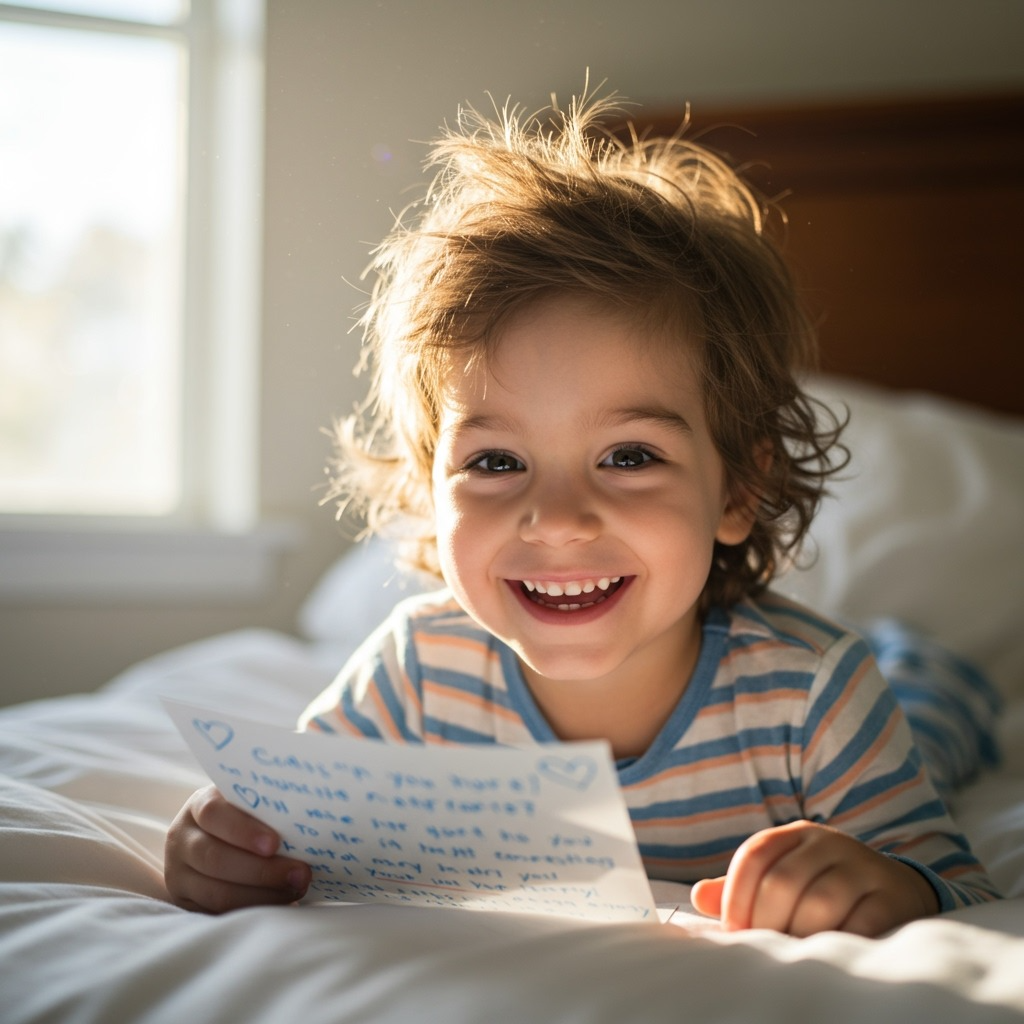
- Leave encouraging notes in their lunchbox or on their pillow
- Verbally praise specific efforts, not just results (“I love how hard you worked on that project”)
- Say “I love you” first, and say it often.
- Compliment them in front of other people (if they’re comfortable with it)
- Give them a special, loving nickname.
One trick that’s been a game-changer for me: I set random reminders on my phone to text my son something positive during the school day. Just a quick “Thinking about you. You’re awesome.” It takes five seconds, but it fills his tank for hours.
Quality Time
This one almost broke me, honestly. Because Quality Time doesn’t mean you just exist in the same room while scrolling your phone. It means undivided attention. Full presence. And in our crazy, busy world, that’s hard.
My middle daughter has this love language, and I didn’t realize it until she started acting out. More meltdowns. More defiance. I couldn’t figure out what was wrong—until I noticed the pattern. Every time I’d been super busy or distracted, she’d spiral. But after even 15 minutes of one-on-one time with no phone, no distractions, just me and her? She’d completely reset.
Quality Time kids don’t need fancy outings or expensive trips (though they’ll love those too). They just need you. According to research from the American Academy of Pediatrics, regular one-on-one time with a parent significantly improves a child’s emotional regulation and behavior.
Here’s how to speak Quality Time:
- Schedule regular parent-child dates (even if it’s just a walk around the block)
- Read together before bed with your phone in another room.
- Let them “help” you with errands or chores.
- Have device-free meals where you actually talk
- Create simple traditions, like Friday night movie night or Sunday morning pancakes.
Here’s what I do now: every week, I put 20 minutes on the calendar for each kid. Non-negotiable. My Quality Time daughter gets that time, and I protect it like it’s a doctor’s appointment. Sometimes we just sit and talk. Sometimes we bake cookies. It doesn’t matter what we do—what matters is that I’m fully there. If you’re looking for more ways to engage meaningfully with your child, check out these fun activities for kids that work perfectly for quality time moments.
Acts of Service
Some kids feel most loved when you do things for them. Not in a spoiled, entitled way—but in a “you care enough to help me” way.
I’ll be honest: I don’t have a child with this as their primary love language, but I have a close friend who does. Her daughter asks for help constantly. “Mom, can you make my bed?” “Mom, can you help me organize my backpack?” For a while, my friend thought her daughter was just being lazy. But once she realized it was her love language, she reframed it.
Acts of Service isn’t about doing everything for your child—it’s about going out of your way to meaningfully help them. It’s showing them, through your actions, that you’ve got their back.
Here’s how to speak Acts of Service:
- Do one of their chores as a surprise
- Fix something that’s been broken.
- Make their favorite meal without being asked.
- Help them with a project or homework.
- Pack their bag for them before a big day.
The key here is balance. You don’t want to raise a kid who can’t do anything for themselves. But you also want to show love in a way they understand. My friend now helps her daughter with things occasionally, while also teaching her to do them herself. It’s a dance, but it works.
Receiving Gifts
Before you panic and think this love language is going to turn your child into a spoiled brat, hear me out. Receiving Gifts isn’t about materialism—it’s about the thought behind the gift. It’s tangible proof that you were thinking about them.
A child with this love language will treasure the rock you picked up on a walk because it reminded you of them. They’ll keep every card you’ve ever given them. They’ll light up when you bring home their favorite snack from the store. The monetary value doesn’t matter—the thoughtfulness does.
One of my daughter’s friends has this love language, and her mom told me that when she was little, she used to make “treasures” for her parents constantly. Drawings, crafts, and little gifts made from sticks and flowers. That was her way of saying “I love you.”
Here’s how to speak Receiving Gifts:
- Bring home a favorite treat without them asking
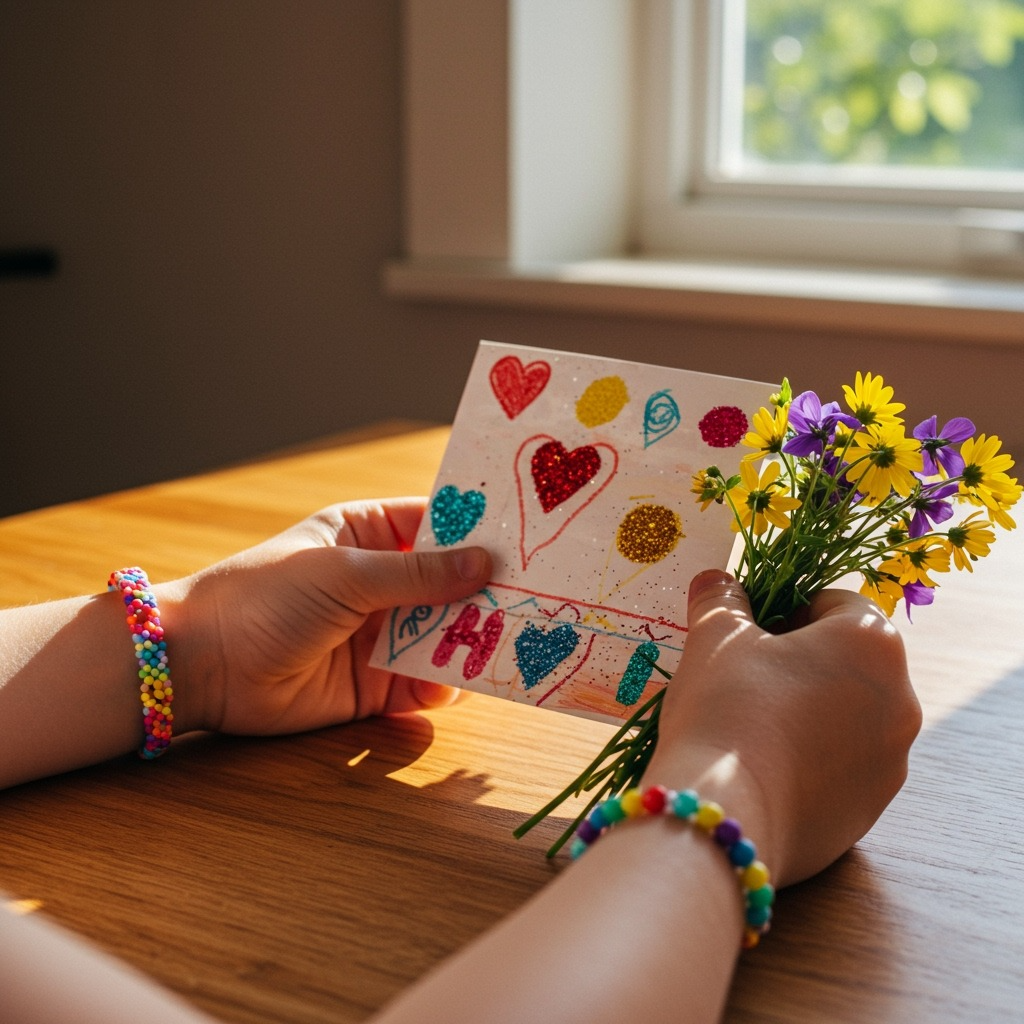
- Make something handmade, like a bracelet or a drawing.
- Pick flowers from the yard and put them in their room.
- Send them a postcard or letter in the mail.
- Give meaningful gifts for special occasions (not expensive—meaningful)
The mom I know started leaving tiny surprises for her daughter—a new sticker on her water bottle, a note with a piece of candy in her lunchbox, a small toy from the dollar store. These little gifts say, “I was thinking about you,” and that’s what fills the tank.
What I Wish I’d Known Sooner
Here’s the thing no one tells you: your love language is probably not the same as your child’s. And that’s where the disconnect happens.
I’m a Quality Time person. So naturally, I was spending time with all my kids, thinking I was nailing it. But my oldest son (Words of Affirmation) didn’t need more time with me—he needed to hear that he was doing a good job. My youngest (Physical Touch) didn’t need another playdate—she needed me to sit still and hold her.
It’s like trying to fill a cup with the wrong liquid. You’re pouring, but nothing’s landing where it needs to.
Once I figured this out, I had to get intentional. I had to speak languages that didn’t come naturally to me. For my Words of Affirmation kiddo, I set phone reminders to say something positive. For my Physical Touch child, I made myself stop and hug her even when I was busy. For my Quality Time daughter, I put my phone away and gave her my full attention.
Was it easy? No. Did it feel awkward at first? Absolutely. But did it work? Yes. A thousand times, yes.
If you’re curious about different parenting approaches that honor your child’s unique needs, you might also find value in exploring gentle parenting books that align with speaking your child’s love language.
Simple Ways to Start Today
Okay, so now you’re probably thinking, “This sounds great, but I’m already overwhelmed. How do I actually do this?”
Here’s the simplest way to start: pick one language and try it this week. That’s it. Just one.
If you think your child might be Physical Touch, give them five extra hugs today. If you think they’re Words of Affirmation, say three specific things you love about them before bed. If you suspect Quality Time, put your phone in a drawer and give them 15 minutes of your full attention.
Start small. Watch how they respond. Adjust from there.
Here’s what I did when I was first figuring this out:
I kept a journal—nothing fancy, just a notes app on my phone. Every day for a week, I wrote down one way I tried to show love to each kid, and I wrote down how they reacted. By the end of the week, clear patterns emerged.
I also asked my older kids directly. I explained the five languages and asked, “Which one makes you feel most loved?” My son didn’t even hesitate: “When you tell me I’m doing a good job.” My daughter thought for a minute and said, “When you play with me and you’re not on your phone.” Boom. There it was.
If you want a more structured approach, there are free quizzes online that you and your child can take together (for older kids who can read). But honestly? You probably already know deep down what makes your child feel loved. You just have to pay attention.
Why This Matters So Much
I used to think that as long as I loved my kids, that was enough. But love isn’t just something you feel—it’s something you do. And more importantly, it’s something your child needs to feel.
Dr. Chapman says it best: “Love can be expressed and received in all five languages. However, if you don’t speak a person’s primary love language, that person will not feel loved, even though you may be speaking the other four.”
That hit me hard. Because I was speaking four languages, but not the one that mattered most to each of my kids.
When your child’s emotional tank is full—when they feel deeply and truly loved—everything gets easier. They’re more cooperative. They listen better. They’re happier. They’re more resilient when life gets hard.
And here’s the beautiful part: when you start speaking their love language, they start speaking yours back. It’s like you’ve unlocked this secret code that makes your whole relationship click into place.
I’m not saying it fixes everything. My kids still fight. I still lose my patience. Parenting is still hard. But the connection? That’s stronger now. And on the hard days, that connection is what gets us through.
Figuring out your child’s love language isn’t about being a perfect parent. It’s about being a present one. It’s about showing up in the way your child needs you to, not just the way that’s easiest for you.
So take a breath. You don’t have to overhaul your entire parenting style overnight. Just start noticing. Start trying. Start speaking your child’s love language, even if it feels clumsy at first.
Because here’s the truth: your kids don’t need you to be perfect. They just need to know, deep in their bones, that they are loved. And when you speak their language, they’ll feel it. I promise.
Frequently Asked Questions
Can a child have more than one love language?
Yes! While every child has one primary love language, they can have a secondary one, too. For example, your child might primarily need Quality Time, but also really appreciate Words of Affirmation. The key is to figure out which one fills their tank the most and focus there first, then sprinkle in the others.
What if my child’s love language is different from mine?
This is actually super common and one of the biggest reasons parents and kids feel disconnected. If your love language is Acts of Service and your child’s is Physical Touch, you might be doing everything for them while they just want a hug. The good news? Once you know this, you can intentionally practice speaking their language, even if it doesn’t come naturally to you.
At what age can I figure out my child’s love language?
You can start identifying love languages as early as toddlerhood, usually around age 2-3. Young children will naturally show you how they give and receive love through their behavior. For older kids (around age 8+), you can actually have conversations with them about it or take quizzes together to figure it out.
Do love languages change as kids get older?
Love languages generally stay consistent throughout life, but the way they’re expressed can change. For example, a Physical Touch toddler who wants constant cuddles might become a teenager who shows love through playful wrestling or sitting close during movies. The core need stays the same, but the expression evolves.
What if I’m a single parent and feel overwhelmed trying to speak multiple love languages?
First, give yourself grace—you’re doing an amazing job. The beauty of love languages is that small, intentional actions make a huge difference. You don’t need hours of quality time; sometimes 10 focused minutes is enough. You don’t need to write novels of affirmation; a quick “I’m proud of you” text works. Start with one child’s language, master that, then move to the next. Progress over perfection.