
Last Tuesday, I thought it would be brilliant to try that classic baking soda volcano with my six-year-old. You know, the one that’s supposed to teach kids about chemical reactions and make you look like Mom of the Year? Yeah, it exploded all over my freshly cleaned kitchen counter, dripped onto the floor, and my daughter lost interest approximately 30 seconds after the eruption ended. I stood there with vinegar-soaked paper towels, thinking, there has to be a better way to do this STEM thing everyone keeps talking about.
That frustrating afternoon sent me down a rabbit hole of STEM activities for kids—the kind that actually work for real moms with real kids who have the attention span of a goldfish. I’m talking about activities that don’t require a Pinterest-perfect setup, won’t destroy your house, and might actually keep your kids engaged for more than five minutes. After testing dozens of activities with my own kids (and cleaning up more messes than I care to admit), I’ve figured out which STEM projects are actually worth your time.

What Are STEM Activities (And Why Should You Care)?
STEM stands for Science, Technology, Engineering, and Mathematics—basically, it’s a fancy way of saying “hands-on activities that make kids think.” But here’s what I wish someone had told me earlier: STEM activities aren’t just about raising the next Einstein. They’re about teaching your kids how to solve problems, think creatively, and not give up when something doesn’t work the first time.
These skills matter way more than memorizing the periodic table. When my daughter built her first LEGO maze and the marble kept falling out, she didn’t run to me crying. She adjusted the walls, tested it again, and eventually figured it out. That persistence? That’s what STEM activities actually teach, and it’s something she’ll use every single day of her life.
The best part is that you don’t need any special equipment or a science degree to make this happen. Most STEM activities use stuff you already have lying around your house—pipe cleaners, plastic cups, rubber bands, and that random collection of LEGOs taking over your living room.
The Mistake I Made With STEM Activities at First
I’ll be honest with you: I used to think STEM activities had to be complicated to be educational. I’d spend hours planning elaborate experiments with specific materials, printed instruction sheets, and backup supplies in case something went wrong. My kids would take one look at my setup and feel overwhelmed before we even started.
Then one rainy afternoon, I gave my son a pile of sticky notes and asked him to match numbers to groups of toys scattered around the living room. He played that “game” for 45 minutes straight, and I realized I’d been making everything way harder than it needed to be. The activities that worked best weren’t the ones that looked impressive—they were the simple, open-ended projects that let kids explore without pressure.
Now I focus on easy STEM activities that feel like play, not homework. And guess what? My kids actually ask to do them, which is pretty much a parenting miracle. If you’re looking for more ways to keep kids engaged without the overwhelm, I’ve found that simple, hands-on activities work better than anything complicated.
Easy Science Activities Your Kids Will Actually Enjoy
Let me share the science experiments that have become staples in our house—the ones my kids request by name and that don’t make me want to hide in the bathroom for 20 minutes afterward.
Cloud in a Jar is ridiculously simple and never gets old. You just need a jar with a lid, hot water, ice, and hairspray. Pour about an inch of hot water into the jar, spray some hairspray inside, quickly place ice cubes on the lid, and watch a cloud form right before your eyes. My kids are mesmerized every single time, and it teaches them about condensation and how real clouds form in the sky. This is perfect for days when you need a quick, impressive activity that requires minimal cleanup.
The Apple Oxidation experiment is another winner, especially because it doubles as a snack. Cut an apple into slices and let your kids predict which slices will turn brown fastest based on what you coat them with—lemon juice, water, or nothing. It teaches the scientific method without feeling like a lesson, and you can tie it into real-world applications like why Mom puts lemon juice on fruit salad.
Growing Romaine from Kitchen Scraps has become a long-term project in our house that my kids check on every morning. Just place the bottom of a romaine lettuce head in a shallow dish of water near a window, and watch it regrow. It takes about a week to see real progress, which teaches patience along with basic biology. Plus, kids love the idea that they’re growing their own food.
For something more dramatic, try the Hot Ice Experiment. This one requires sodium acetate (which you can make from baking soda and vinegar, or just buy hand warmers), and it creates a substance that looks like ice but is actually warm to the touch. The chemical reaction is impressive enough to keep older kids interested, and it sparks great conversations about states of matter.
When your kids ask “Why is the sky blue?” for the 47th time, turn it into an actual experiment. Fill a clear glass with water, add a small amount of milk, and shine a flashlight through it from the side. The water will appear blue from certain angles, demonstrating light scattering—the same reason our sky looks blue. This one blew my eight-year-old’s mind and finally got him to stop asking me that question every single day.

Technology & Coding Activities (No Scary Math Required)
I used to think coding was too advanced for my kids, something they’d learn in middle school when I could outsource it to actual teachers. Then I discovered platforms like Scratch and Tynker, and I realized coding for kids is basically like digital LEGO building—creative, visual, and way more fun than I expected.
Scratch (available free at scratch.mit.edu) lets kids create their own games and animations by snapping together colorful code blocks. My daughter made a game where a cat chases a mouse, and she was so proud that she showed it to literally everyone who came to our house for a week. The best part is that it teaches sequencing, logic, and problem-solving without feeling like “learning.” You don’t need any coding experience yourself—the platform is designed for kids to explore independently with just occasional guidance.
For younger kids or those who prefer hands-on activities, try a LEGO Maze Coding Game. Build a simple maze with LEGO bricks, then create instruction cards that say things like “Forward,” “Turn Left,” “Turn Right.” Your kid arranges the cards in sequence to guide a LEGO figure through the maze, which teaches the exact same sequencing concepts used in computer programming. This activity is brilliant because it makes coding tangible—kids can see the immediate result of their “code” and adjust when something doesn’t work.
NASA offers a free Mars Exploration Scratch Project where kids program a virtual rover to collect rock samples on Mars. It combines space exploration (which most kids find inherently cool) with real programming concepts. My son spent an entire Saturday afternoon on this, and I didn’t even have to ask him to get off his tablet—he was actually learning something valuable.
If you have any broken electronics lying around (old keyboards, remote controls, calculators), let your kids take them apart to see the technology inside. Provide a screwdriver and let them explore. It’s not exactly “coding,” but it demystifies technology and shows them that these devices aren’t magic—they’re made of parts that work together. Just make sure batteries are removed first, and supervise the whole thing so nobody puts tiny parts in their mouth.
Engineering Challenges That Don’t Require a Garage Full of Supplies
Engineering activities sound intimidating, but they’re honestly just building challenges with a fancy name. And kids naturally love building things, so these activities are usually the easiest sell.
The Gumdrop Bridge Building Challenge has saved me on multiple rainy days. Give your kids a bag of gumdrops (or mini marshmallows) and a box of toothpicks, then challenge them to build the strongest bridge possible. Test it by placing small toys on top until it collapses. This teaches basic engineering concepts like weight distribution and structural integrity, plus they can eat the building materials when they’re done, which is basically the dream. Looking for more engaging activities for kids that combine learning with play? We’ve got you covered.
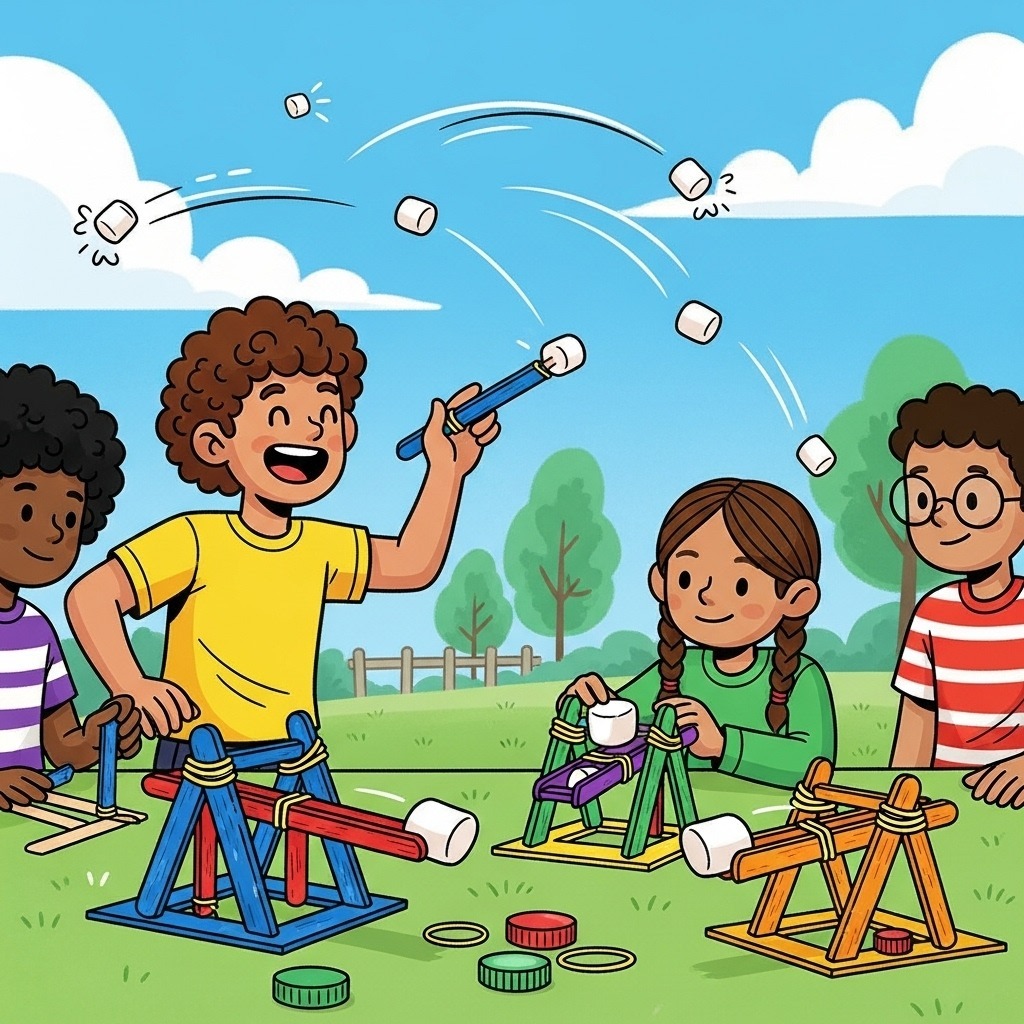
A Marshmallow Catapult is another favorite that feels more like a toy than an educational activity. Use popsicle sticks, rubber bands, and a plastic spoon to create a simple catapult, then launch mini marshmallows across the room. My kids turned this into a competition to see who could launch their marshmallow the farthest, and they naturally started experimenting with different designs to improve distance. That trial-and-error process? That’s engineering.
Building a Marble Maze from cardboard, straws, and tape teaches spatial reasoning and problem-solving. Kids design a maze on a piece of cardboard, use cut straws to create walls and tunnels, then test whether a marble can make it from start to finish. When it doesn’t work (and it rarely works on the first try), they have to figure out why and make adjustments. This activity can keep kids busy for hours, and the end result is a toy they actually want to play with again.
For a science-meets-engineering hybrid, try the Stick Raft activity. Collect sticks from your yard, bind them together with string or rubber bands to create a small raft, then test it in a bathtub or large bowl to see if it floats. Kids can experiment with different configurations and test which items make the raft float better or sink. This introduces basic concepts of buoyancy and density in a way that doesn’t require any explanation from you—the raft either floats or it doesn’t, and kids naturally start asking why.
The Propeller-Powered Car sounds complicated, but you can make a simple version with a cardboard box, bottle caps for wheels, and a small propeller (or a balloon) for power. Kids learn about energy transfer and motion while building something that actually moves. If you want to try this, consider picking up a kids’ activity book that includes templates and step-by-step instructions—it takes the guesswork out and makes these projects way less stressful for you.
Math Activities They Won’t Realize Are Math
The secret to making kids enjoy math is never calling it math. These activities teach genuine mathematical concepts through play, and your kids will have so much fun they won’t realize they’re learning.
A Math Scavenger Hunt turns your home or neighborhood into an outdoor classroom. Create a list of challenges like “Find something circular,” “Count the steps between two trees,” “Measure the length of the couch with your hands,” or “Find three items that are the same height.” Kids race around completing tasks while naturally using concepts like measurement, geometry, counting, and estimation. This activity is perfect for burning energy while sneaking in education, and you can adapt it for any age or skill level.
Sticky Note Number Match is deceptively simple but incredibly effective for younger kids. Write numbers on sticky notes, then create groups of objects (toys, rocks, drawings) around the room. Kids have to match the correct number to each group. This reinforces counting and number recognition through movement and visual matching. My four-year-old asks to play this “game” all the time, completely unaware that she’s practicing early math skills.
The cheapest math manipulatives are already in your pantry. Use animal crackers, goldfish, or gummy worms for sorting, counting, and basic addition problems. Kids can sort them by color or type, divide them into groups, compare quantities, or solve simple word problems—and then eat the math lesson when you’re done. A muffin tin or ice cube tray provides visual prompts for sorting activities.
A Balance Scale Activity teaches measurement, weight comparison, and even basic algebra concepts (if this equals that, then this must weigh…). You can buy a simple balance scale, or make one from a coat hanger, string, and two plastic cups. Kids experiment with different objects to see which is heavier, or try to balance the scale perfectly. This hands-on exploration builds mathematical intuition better than any worksheet ever could.
The Rubber Duck Math Game pairs literacy with math. Read 10 Little Rubber Ducks by Eric Carle as a family, then create your own math problems using toy ducks or other small figures. “If three ducks float away and two come back, how many are left?” becomes way more engaging when kids can physically manipulate the objects. This concrete representation helps younger children understand abstract mathematical concepts.
For kids who love being outside, outdoor games and activities naturally incorporate counting, measurement, and spatial reasoning—they just don’t feel like traditional math lessons.
My Go-To STEM Activities by Age Group
Not every activity works for every age, and I learned this the hard way when my three-year-old got frustrated with a coding challenge meant for eight-year-olds. Here’s what actually works for different developmental stages.
Ages 3-5 (Preschool): At this age, keep it simple and sensory-focused. Sticky Note Number Match, sorting activities with household items (rocks, shells, toy animals), building with blocks, and simple sink-or-float experiments in the bathtub work best. These activities build foundational concepts without requiring reading or complex instructions. The Balance Scale Activity is also perfect for this age because it’s visual and hands-on. Don’t forget that toddler board games can introduce basic STEM concepts like counting, patterns, and cause-and-effect.
Ages 6-8 (Early Elementary): This is the sweet spot for most STEM activities. Kids this age can handle multi-step projects like the Gumdrop Bridge, Marshmallow Catapult, Cloud in a Jar, LEGO Maze Coding, and Math Scavenger Hunt. They’re developing reading skills, so they can follow simple written instructions with some support. They also have the patience for activities that take 20-30 minutes from start to finish. Scratch coding becomes accessible for kids on the older end of this range.
Ages 9-12 (Upper Elementary): Older kids are ready for more complex challenges that involve planning, testing, and refining. They can handle robotics projects, more advanced Scratch programming, including game design, multi-variable experiments like testing bridge strength with different materials, and longer-term projects like crystal growing. These kids benefit from activities that have multiple possible solutions, giving them room to innovate and personalize their approach. They’re also at an age where understanding the “why” becomes important, so explaining the science behind experiments adds value.
If you’re wondering what kids like to do at different ages, the answer is usually “build stuff, make messes, and show off what they made”—which is exactly what STEM activities provide.
The Supplies I Always Keep Stocked for Last-Minute STEM Fun
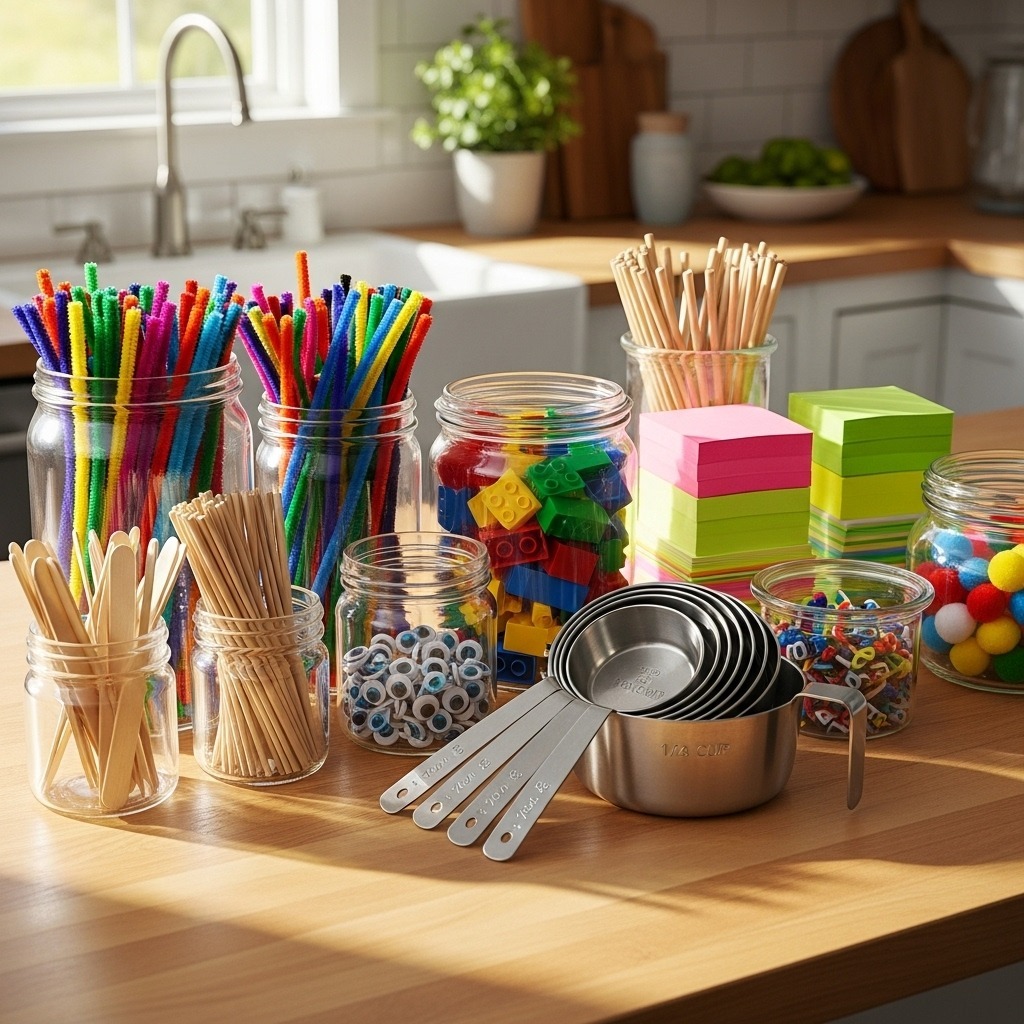
The difference between actually doing STEM activities and just pinning them on Pinterest often comes down to having the right supplies readily available. I keep a dedicated “STEM bin” in our playroom with these essentials, and it’s saved me countless times when I need a quick activity on a rainy day or when screen time has gone on too long.
Always-stocked household items: Clear jars with lids, rubber bands, string or yarn, tape (both regular and masking), scissors, plastic cups, popsicle sticks, toothpicks, straws (the paper kind work great), balloons, and coffee filters. These items are cheap, multi-purpose, and work for dozens of different activities. I buy them in bulk and don’t feel guilty when projects get messy or things break—it’s all part of the learning process.
Craft supplies worth having: Pipe cleaners are incredibly versatile for building structures and creating shapes. LEGOs or other building blocks are essential for both open-ended play and structured engineering challenges. Sticky notes work for sorting games, matching activities, and even building structures. Modeling clay or play-dough teaches sculpting and fine motor skills while being STEM-adjacent.
Food items that double as learning tools: Gumdrops, mini marshmallows, gummy worms, and animal crackers are all useful for various building and math activities. They’re edible, which means kids are extra motivated to complete projects, and cleanup is delicious. Just buy them when they’re on sale and keep them in your pantry specifically for STEM activities, not for regular snacking.
Natural materials from outside: Rocks, shells, sticks, leaves, pine cones, and acorns are completely free and work brilliantly for sorting, counting, building, and science observations. Go on a nature walk and collect a variety of items in different sizes, shapes, and textures. Store them in a clear bin so kids can see what’s available and get inspired to create.
Science-specific supplies: Baking soda and vinegar are the foundation of countless experiments and cost almost nothing. Food coloring adds visual interest to any water-based activity. A set of measuring cups and spoons teaches both math and science concepts. A magnifying glass opens up a whole world of close observation. If you want to level up, a simple kids’ craft supply kit or even an organized craft warehouse can provide months of STEM project materials in one purchase.
Tech tools that aren’t screens: Seriously, you don’t need fancy gadgets. But if you want to invest in something, a simple digital scale, a timer, and a basic tool set with child-safe screwdrivers can expand your STEM possibilities significantly. Kids love using “real” tools, and it makes them feel like actual scientists and engineers.
What to Do When STEM Activities Go Wrong (Because They Will)
Let me tell you about the time my son’s crystal sun catcher experiment exploded because I used boiling water instead of hot water, and we ended up with sticky borax solution all over the kitchen floor and counter. I wanted to cry, my son looked devastated, and I seriously considered giving up on this whole STEM thing entirely.
But here’s what I’ve learned: The activities that go wrong are often the most valuable ones. When that crystal experiment failed, we talked about what happened, looked up what we did wrong, and tried again the next day—and those crystals turned out beautifully. My son learned that failure isn’t the end of the story; it’s just information that helps you do better next time.
Managing messes is about expectations. If you go into a STEM activity expecting perfection, you’ll be disappointed and stressed. Instead, prep your space like you’re preparing for a toddler art project: cover surfaces with newspaper or a cheap plastic tablecloth, keep paper towels nearby, and do messy activities in the kitchen or bathroom where cleanup is easier. I also have a “mess apron” that my kids wear (just an old, oversized t-shirt), so I don’t worry about their clothes.
Handling frustration is a skill both you and your kids need to develop. When an engineering project keeps collapsing or a marble maze doesn’t work right, kids get frustrated. I try to ask questions instead of fixing things for them: “What do you think happened? What could we try differently?” Sometimes we take a break, have a snack, and come back to the project later. And sometimes we just declare the project a learning experience and move on to something else—and that’s completely fine.
Turning failures into learning is the whole point of STEM activities. If everything worked perfectly the first time, kids wouldn’t learn problem-solving. When a catapult launches marshmallows backward instead of forward, we laugh about it, figure out why, and adjust. When a homemade boat sinks immediately, we examine similar activities online or try different materials. The conversation about why something didn’t work teaches more than a Pinterest-perfect success ever could.
I also learned to lower my expectations about what “success” looks like. My kids don’t need to build a perfectly engineered bridge or create a complex Scratch game. They just need to engage with the process, try things, and think about what happens. That’s the real goal, and anything else is just a bonus.
If you’re working on gentle ways to guide kids through frustration, positive parenting techniques can help you respond supportively when STEM activities don’t go as planned.

Making STEM a Natural Part of Your Week
You don’t need to schedule formal “STEM time” for these activities to be valuable. Some of our best learning moments happen spontaneously—when my daughter asks why soap makes bubbles, we look it up together and then create our own bubble solution to test variables. When my son wonders which toy car rolls fastest, we set up a ramp and test them, naturally incorporating physics concepts without calling it that.
I try to keep a mental list of 2-3 easy activities I can pull out when the moment is right: when it’s raining and the kids are bored, when we have friends over and need an activity, or when I need 20 minutes to finish a work call and want them doing something productive. Having that STEM bin stocked means I can say “yes” more often when kids propose crazy ideas, because I have the materials to support their curiosity.
The biggest shift in my thinking came when I stopped seeing STEM activities as something extra I had to do and started seeing them as a different kind of playtime. Kids are natural scientists—they observe, question, hypothesize, and test constantly. Our job isn’t to teach them to think scientifically; it’s to provide materials and space that support the scientific thinking they’re already doing. When you look at it that way, STEM activities feel less like homework and more like giving your kids the tools they need to explore their world.
And honestly? The more STEM activities we do, the more I find myself learning alongside my kids. I didn’t know why the sky was blue until we did that experiment together, and watching crystals form over several days was just as magical for me as it was for them. These activities give us something to do together that doesn’t involve screens, creates natural conversation opportunities, and builds memories. My daughter still talks about the time we built a cardboard marble maze together six months ago, which tells me the value goes far beyond the specific science concepts learned.
If you’re looking for ways to balance structure with flexibility in your parenting approach, understanding different parenting styles can help you find the right balance for STEM activities and everything else.
Frequently Asked Questions About STEM Activities for Kids
At what age should you start STEM activities with kids?
You can start STEM activities as early as age 2-3 with very simple experiences like sorting toys by color, exploring how objects sink or float in the bath, or building with blocks. At this age, activities should be short (5-10 minutes), sensory-focused, and have no wrong answers. Even just measuring ingredients while cooking together introduces early math and science concepts. The key is matching activities to your child’s developmental level and letting them explore without pressure.
What are easy STEM activities to do at home with no special equipment?
Some of the best STEM activities use items you already have: building structures with household items like cups and cardboard, sorting and counting with toys or food items, making predictions about which objects will sink or float, creating ramps with books to race toy cars, or doing simple cooking projects that involve measuring. The Sticky Note Number Match game requires only sticky notes and toys, while the Math Scavenger Hunt needs just paper and a pencil. Even just taking apart old electronics with a screwdriver teaches kids about technology.
How do I make STEM activities fun instead of feeling like homework?
The secret is to never call them “learning activities” or “educational projects”—just call them experiments, games, or challenges. Let kids choose which activities interest them, allow for messy exploration without correcting every mistake, and focus on the process rather than getting a “right” answer. Using food items that can be eaten afterward (like gumdrop bridges or animal cracker math) adds extra motivation. Also, do the activities alongside your kids rather than just supervising—your enthusiasm is contagious. If your kids need a break from structured activities, board games like Bluey Monopoly Junior or Candy Land Bluey Edition can incorporate STEM concepts like counting and strategy in a playful format.
What if my child gets frustrated and wants to quit during a STEM activity?
Frustration is actually a valuable part of the learning process, but you need to help your child work through it rather than either forcing them to continue or immediately rescuing them. Try asking questions like “What do you think went wrong?” or “What could we try differently?” rather than fixing the problem for them. Sometimes, taking a short break and returning to the project later helps reset emotions. It’s also completely okay to abandon a project that isn’t working—model that flexibility by saying something like “This one isn’t working for us today, let’s try something different.” Teaching kids to set boundaries around their emotions includes accepting when they need to step away from a challenging activity.
How can I incorporate STEM learning into everyday activities without planning special projects?
The best STEM learning often happens spontaneously in daily life. While cooking, let kids measure ingredients and predict what will happen when you mix things (science and math). During grocery shopping, have them estimate weights or costs (math). When you see a cool building or bridge, talk about how it was engineered to stand up. Let kids help with household repairs so they see how tools work (engineering). Point out patterns in nature during walks—symmetry in leaves, spirals in shells, geometric shapes in spiderwebs. Answer “why” questions by exploring together rather than just giving answers. These everyday moments build scientific thinking without requiring any special setup.