
“Can I take my booster seat out now?” my nine-year-old asked from the back seat as we pulled into the parking lot. She’d just turned nine, and apparently, that meant it was time in her mind. I hesitated because I actually wasn’t 100% sure of the answer, and that moment of uncertainty sent me into research mode.
Turns out, booster seat safety isn’t as simple as hitting a certain birthday. There’s actual science involved, legal requirements vary by location, and most importantly, there’s a specific test you can use to know for sure when your child is actually ready. That discovery changed everything about how I think about car safety for my kids.
When kids can stop using a booster seat isn’t just a question about age. It’s about height, weight, maturity level, and making sure the vehicle’s seat belt actually fits your child’s body correctly. Getting this right could literally be the difference between safety and serious injury in a car accident.
Why Booster Seats Matter More Than You Think
I used to think booster seats were just one of those things — another car safety requirement you follow until the law says you don’t have to. Then I learned what a booster seat actually does, and it completely changed my perspective.
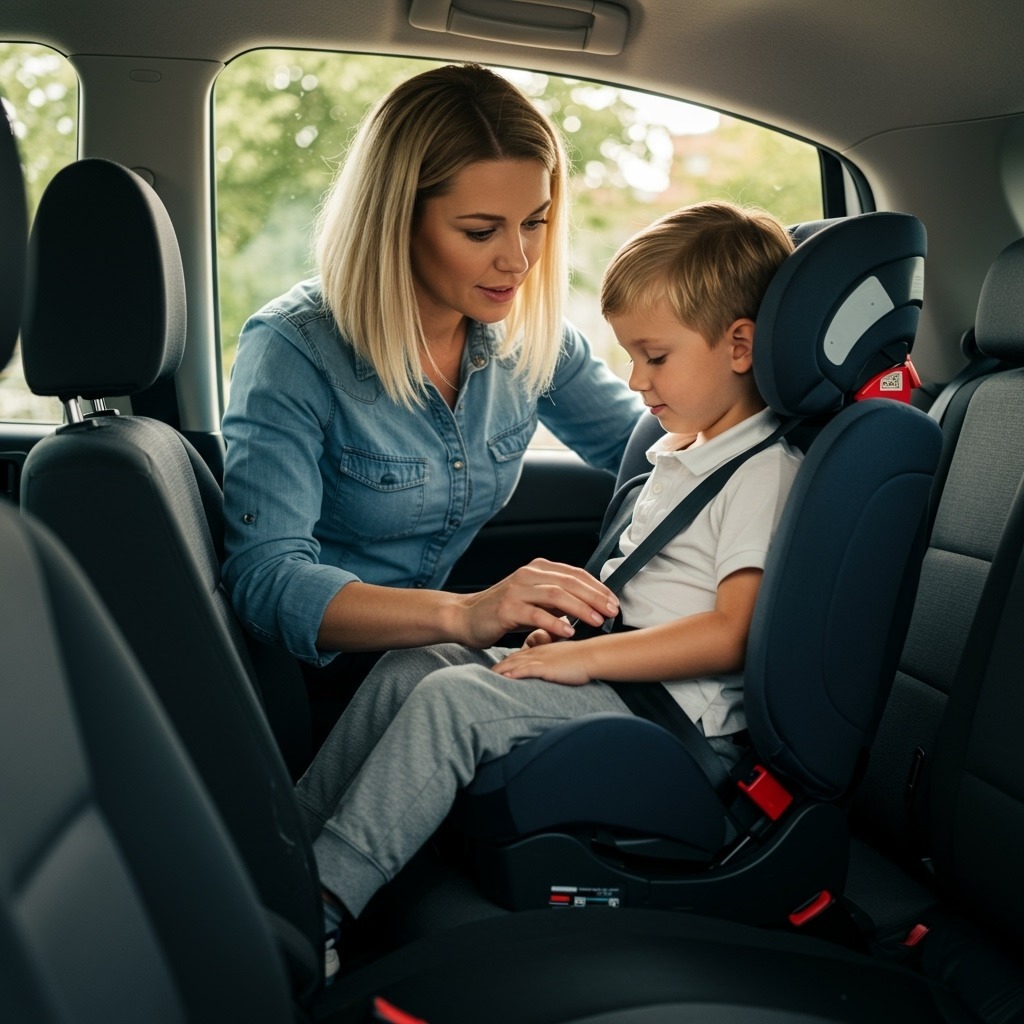
Adult seat belts are literally designed for adults. They sit too high on a child’s body, crossing their neck or face instead of their chest. The lap belt sits on their stomach instead of their hips. That positioning is dangerous in a crash because it puts pressure on all the wrong places. A booster seat raises your child up so the adult seat belt fits properly across their shoulder and chest, and the lap belt sits low across their hips and thighs — exactly where it should be.
Without a booster seat, your child isn’t just uncomfortable — they’re at serious risk of injury. According to the National Highway Traffic Safety Administration, booster seats reduce the risk of serious injury by about 45% for children compared to using a seat belt alone.
Making tough parenting safety decisions like this is part of how to be a good mother — choosing what’s right for your child even when it’s inconvenient or unpopular.
The Legal Requirements for Booster Seats in the United States
Here’s where it gets confusing — because the legal requirements vary depending on where you live. But let me break down what’s most common and what the recommendations are.
Federal guidance and most state laws require children to stay in a booster seat until they’re at least 8 years old AND 4 feet 9 inches tall. That’s approximately 145 centimeters. This is the absolute legal minimum in most states, but it’s not necessarily the safest option — it’s just the legal threshold.
Some states have stricter requirements. Ohio, for example, requires booster seats until age 8 OR 4 feet 9 inches tall. Other states go even further with their recommendations. The American Academy of Pediatrics recommends keeping children in a booster seat until they’re closer to 10 to 12 years old because that’s when most children are actually tall enough for an adult seat belt to fit properly.
In 2025, new car seat safety standards went into effect. Booster seats now require a minimum weight of 40 pounds and 43 inches. If your child is under 40 pounds, they need to stay in a harnessed car seat instead of a booster. This change means bigger, heavier children should stay rear-facing or in a forward-facing harness seat longer than they used to.
Check your specific state’s laws because they do vary. What’s legal in California might be different than what’s legal in Texas. You can find your state’s specific requirements online, but the general rule is: follow the stricter of either the age requirement OR the height requirement for your state, plus use common sense about whether the seat belt actually fits your child properly.

The Real Test: Does Your Child Actually Fit in an Adult Seat Belt?
Forget about age and height for a second. Here’s the real test that matters: can your child actually fit in an adult seat belt safely?
There’s something called the “5 Step Test” that’s way more reliable than just counting birthdays or measuring height. If your child can pass this test, they might be ready to transition out of a booster seat. If they can’t pass all five steps, they need to stay in the booster regardless of their age.
Step 1: Does your child sit with their back flat against the vehicle seat? Not slouching, not leaning forward — can they sit with their entire back against the car seat? This is important for proper positioning.
Step 2: Can their feet reach the floor without slouching? Their knees should bend at the edge of the seat naturally. If they’re dangling their legs or stretching, they’re not ready yet.
Step 3: Does the lap belt fit low across their hips and thighs? The lap belt should NOT sit on their stomach or belly. It should be low on their hips. If it rides up to their stomach, they’re too small.
Step 4: Does the shoulder belt cross the middle of their shoulder and chest? Not the neck, not the face, not under their arm — right across the middle of the shoulder and down through the chest. If it’s crossing their neck or face, they need a booster to raise them up.
Step 5: Can they stay in this position comfortably for the entire trip? Not just for a five-minute drive. Can they maintain a proper seat belt position for a full hour or longer? If they’re a wiggler who can’t sit still, they probably need the booster to keep them in place.
Your child needs to pass ALL FIVE steps. If they fail even one, they’re not ready yet. This is where most parents get it wrong. They focus on age or height but forget to actually test if the seat belt fits properly. I recommend actually having your child sit in the car with an adult seat belt and checking each of these steps yourself. Nationwide Children’s Hospital has excellent resources for walking through this test in detail.
Age Guidelines: What the Research Actually Says
While the legal minimum varies, research gives us pretty clear guidance on when children are actually ready.
Under 8 years old? Stay in a booster seat. Period. There’s no research that shows children under 8 are safe using adult seat belts alone. The anatomy just isn’t there yet.
8 to 10 years old: This is the transition zone. Your child might legally be allowed to stop using a booster at 8, but they probably shouldn’t yet. Most children this age still don’t fit properly in adult seat belts. The American Academy of Pediatrics recommends waiting until at least age 10, and many safety experts recommend age 12.
10 to 12 years old: Most children in this range are starting to fit properly in adult seat belts, but check with the 5 Step Test first. Some kids are ready at 10, some need to wait until 12.
12 years and older: Most children this age can use adult seat belts safely. But still use the 5 Step Test to be absolutely sure, especially if your child is smaller or less mature.
The key takeaway? Age is just one factor. Height, weight, AND ability to sit still in a proper position all matter. A small 10-year-old might need a booster longer than a large 9-year-old. Every child is different. The American Academy of Pediatrics emphasizes that most children won’t properly fit in vehicle seat belts until they’re 10 to 12 years old, regardless of what the law allows.
Common Mistakes Parents Make With Booster Seats
I see so many parents making these mistakes, and I made a few myself before I really understood booster seat safety.
Transitioning too early because it’s convenient. Just because your child turned 8 or hit 4 feet 9 inches doesn’t mean you need to take the booster out immediately. The booster is still protecting them better. Comfort and convenience aren’t good reasons to stop using it.
Use backless boosters when high-back boosters are needed. Backless boosters are cheaper and take up less space, but they don’t provide head and neck support in a side-impact crash. High-back boosters are safer. If your vehicle has a low seat back or no headrest, use a high-back booster.
Not checking the 5 Step Test. So many parents use age as the only guideline and skip the actual physical test. This is the biggest mistake. The 5 Step Test is more important than age or height.
Letting kids put the shoulder belt behind their back or under their arm. This seems like a comfort thing, but it completely defeats the purpose of the seat belt. That shoulder belt needs to cross their chest for protection. If they’re doing this, they’re not developmentally ready to use an adult seat belt.
Letting kids in the front seat too early. Even if they can pass the 5 Step Test, kids under 13 should ride in the back seat. The back seat is significantly safer in a crash. Front airbags are designed for adults and can actually injure children.
Assuming a booster seat that’s expired is still fine. Car seats do expire — usually around 6 to 10 years, depending on the model. Check your booster seat for an expiration date. If it’s expired, it’s time to replace it.

What About Special Situations?
Some parents have specific questions that don’t fit neatly into the standard guidelines.
My child has sensory issues and hates the booster. I get it, but pushing through that and keeping the booster is the safer choice. Some kids have a genuine sensory issue with booster seats. If that’s the case, talk to your pediatrician about how long you should continue using it. Don’t let comfort override safety. For more insights on understanding kids’ sensory needs, explore positive discipline techniques for toddlers, which include information about managing frustration during car rides.
My child is much smaller/larger than average. Go by the actual fit in the car, not by age. If your child is very small for their age, they might need the booster longer. If they’re very large, they might be ready sooner. But still do the 5 Step Test to be sure.
We have a small car, and the booster takes up a lot of room. Safety comes first, then finding creative solutions. Can you use a backless booster to save space? Can you adjust the front seat? Can you take turns driving different family members? There are solutions, but “the booster is inconvenient” isn’t a good reason to skip it.
My child goes between two households with different cars. Each car should have an appropriate car seat or booster for your child’s size. It might mean buying two boosters, but that’s what’s necessary for safety. Some parents try to skip the booster in one car to save money, but that puts your child at risk in that specific vehicle.
According to NHTSA, consistency in using the correct seat at the correct stage is one of the best things you can do for child passenger safety.
The Emotional Side: When Kids Want Out of the Booster
Here’s the part nobody talks about — the emotional resistance from kids when they feel like they’re “too old” for a booster seat.
My daughter started complaining about her booster seat around age 8. Her friends were already in just seat belts, and she felt left behind and “like a baby.” It was hard watching her feel embarrassed about something I knew was keeping her safe.
I solved it by being honest with her. I explained that booster seats aren’t about age, they’re about size and safety. I showed her the 5 Step Test and let her help check if she passed each step. Spoiler alert: she didn’t pass yet, so we had a concrete reason to keep the booster that she understood.
I also validated her feelings. “I know it feels uncool that you still need a booster. But the reality is that your bones and body aren’t fully developed yet, and the seat belt won’t protect you properly without it. Using the booster now means you get to have a long, healthy life to be cool in.”
That framing helped a lot. She still wasn’t thrilled about the booster, but she understood it wasn’t about her being babyish — it was about physics and how her body is different from an adult’s body. For more strategies on managing kids’ big emotions, check out things to say to your child instead of stop crying.
You can also involve older kids by letting them help you research booster seat safety, read the guidelines, or even be the “safety expert” on road trips. Giving them ownership over understanding the why can turn resistance into acceptance.

Making the Transition: When to Ditch the Booster
When your child does pass the 5 Step Test and you’re confident they’re ready, here’s how to make the transition smoothly.
Start with shorter drives. Don’t take the booster out and immediately do a long road trip with just the seat belt. Practice with short drives first while you’re adjusting to how they sit and making sure they’re remembering proper seat belt position.
Give them responsibility. Make it their job to check that the shoulder belt is across their chest, not their neck. Have them verify that the lap belt is low on their hips. This teaches them to own their safety.
Make it a milestone. Acknowledge that they’re growing up and ready for this next step. Maybe celebrate it with something small, like their favorite snack on the first full day without the booster.
Keep reinforcing proper positioning. Just because they’re out of the booster doesn’t mean they automatically know how to sit correctly in a seat belt. Remind them regularly for the first few weeks or months.
Still follow the age guidelines. Even when they’re out of the booster, all children under 13 should ride in the back seat. This is a separate safety rule from the booster seat transition.
Be prepared to go back if needed. If you transition out of the booster and then realize your child is fiddling with the seat belt, slouching, or not sitting properly, you can always put the booster back in. Safety isn’t linear — sometimes we make adjustments.
Remember, there’s no prize for getting rid of the booster seat earliest. There IS a prize for raising a child who makes it to adulthood without serious injury. Keep that perspective when you’re making this decision. For more on making safety decisions as a parent, visit How to be a good mother, which emphasizes that good parenting often means making unpopular choices for safety.
FAQ: When Can Kids Stop Using a Booster Seat?
This is common, especially around ages 8-10, when kids feel self-conscious. Stay firm about safety. Explain the 5 Step Test and why the booster is necessary. Let them help research car safety online. Involve them in understanding the “why.” Don’t let complaints override safety, but do validate their feelings about wanting to grow up. Keep the booster in place until they’re truly ready.What’s the legal age to stop using a booster seat?
In most U.S. states, children can legally stop using a booster seat at age 8. However, some states require booster seats until age 8 AND they reach 4 feet 9 inches tall (145 cm). Always check your specific state’s requirements, as they vary. The legal minimum is different from what safety experts recommend, which is typically age 10-12.
What if my child is very small for their age?
Keep them in the booster seat longer. Size matters more than age. If they can’t pass the 5 Step Test, they need the booster regardless of how old they are. Some children need boosters until age 10 or 11 because they’re smaller. Use actual fit as your guide, not the calendar.
Is it safe to use a backless booster?
Backless boosters are legal and cheaper, but high-back boosters provide better head and neck support in side-impact crashes. If your vehicle has a low seat back or no headrest, a high-back booster is safer. High-back boosters aren’t necessary if your vehicle has a good headrest, but they’re always the better choice if space allows.
Can my child use just a seat belt before age 8?
Not safely. Children under 8 should not use adult seat belts alone. Adult seat belts are designed for adult bodies and don’t fit children properly. A booster seat is necessary to position the seat belt correctly on a child’s body. This is one of the few car safety rules that’s truly non-negotiable.
My child passes the 5 Step Test, but is only 7 years old. Can they stop using the booster?
While your child may physically fit the seat belt, experts still recommend keeping children in booster seats until at least age 8-10. The 5 Step Test tells you about physical fit, but it doesn’t account for maturity level and impulse control. A 7-year-old might be able to sit properly one moment and slouch the next. Age matters too, not just the physical test.
What if my child refuses to use the booster seat?
This is common, especially around ages 8-10, when kids feel self-conscious. Stay firm about safety. Explain the 5 Step Test and why the booster is necessary. Let them help research car safety online. Involve them in understanding the “why.” Don’t let complaints override safety, but do validate their feelings about wanting to grow up. Keep the booster in place until they’re truly ready.