
I’ll never forget the panic I felt at my son’s first birthday party. My friend’s daughter, who was two weeks younger, toddled over and clearly said “cake” while pointing at the dessert table. Meanwhile, my little guy was babbling “ba-ba-ba-ba” at anyone who’d listen. I smiled and nodded, but inside I was spiraling. Why wasn’t he talking yet? Was something wrong?
Spoiler alert: He was totally fine. He said his first clear word (“dog”) three weeks later, and by 18 months, I couldn’t get him to stop talking. But in that moment at the party, I was convinced I’d somehow failed him.
If you’re here because you’re wondering when babies say their first word — and secretly comparing your baby to every other baby you know — I see you. The answer isn’t as simple as a single number, and that’s actually really good news. Let me walk you through what’s normal, what counts as a “real” first word, and how to support your baby’s speech development without losing your mind in the process.
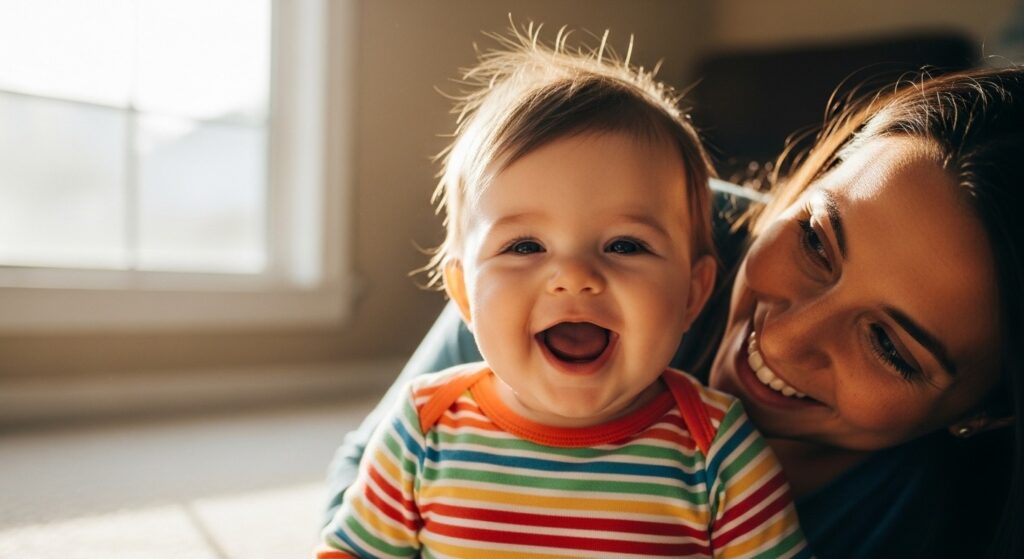
What Actually Counts as a First Word?
Here’s something I wish someone had told me earlier: your baby’s first word doesn’t have to sound perfect to count.
Speech therapists and pediatricians define a first word as any sound that your baby uses consistently to mean the same thing. So if your 11-month-old says “baba” every single time they want their bottle, that counts. If they say “dah” while pointing at the dog every day, that’s a word too.
The key is consistency and intent. Random babbling — even if it accidentally sounds like “mama” — doesn’t count unless your baby is actually trying to communicate something specific. This was a game-changer for me because I realized my son had been “talking” for weeks before I gave him credit for it.
He’d been saying “buh” for ball since about 10.5 months, but I didn’t count it because it wasn’t a perfect “ball.” Big mistake. He was communicating clearly; I just had impossibly high standards.
According to experts, babies don’t need to pronounce words perfectly for them to be considered real words. What matters is that they’re attaching meaning to sounds and using them purposefully to communicate with you.
The Real Answer: When Do Babies Say Their First Word?
Okay, here’s what the research and pediatricians actually say: most babies say their first word somewhere between 10 and 14 months of age. The sweet spot tends to be right around their first birthday, 12 months.
But — and this is a big but — some perfectly normal, developing-just-fine babies don’t say their first clear word until 16 or even 18 months. And on the flip side, some babies start saying recognizable words as early as 7 to 9 months.
The range is huge, which can feel frustrating when you’re trying to figure out if your baby is “on track.” But this wide variation is actually completely normal. Language development is one of those milestones that has massive individual differences, kind of like walking.
My daughter walked at 9 months. My son didn’t walk until 14 months. Both were totally typical. Same thing with talking.
What influences when a baby starts talking? Lots of things: genetics, how much they’re exposed to language, whether they have older siblings (who often either speed things up or slow things down because they “translate” for the baby), temperament, and even whether they’re focusing their development energy on physical skills instead of verbal ones.
The American Academy of Pediatrics notes that boys often start talking a bit later than girls on average, though there’s plenty of overlap. Firstborns sometimes talk earlier because they get more one-on-one conversation time with adults.
If you’re tracking your baby’s development and want more insights into other milestones, these developmental milestone books have been incredibly helpful for me in understanding the full picture without getting too stressed about any single skill.
Before the First Word: What You’ll Hear
Your baby has been working toward that first word since the day they were born. Here’s what the journey typically looks like:
Birth to 3 Months
Your newborn communicates through crying (obviously) and starts making sweet cooing sounds. Those little “ooh” and “ahh” noises? That’s your baby experimenting with their vocal cords. They’re also learning that making sounds gets your attention, which is the foundation of all communication.
4 to 6 Months
This is when things get fun. Your baby starts making more varied sounds — squeals, raspberries, vowel sounds. They’re testing out what their mouth can do. You might hear random consonant sounds mixed in with vowels. My daughter went through a phase where she just shrieked at the top of her lungs to see what would happen. (What happened was that we all lost our hearing for a bit, but she was thrilled with herself.)
6 to 9 Months
Welcome to the babbling stage. This is when you’ll hear those repetitive consonant-vowel combinations: “ba-ba-ba,” “da-da-da,” “ma-ma-ma.” It sounds like talking, but your baby isn’t attaching meaning to it yet. They’re just practicing the sounds and rhythms of language. You might think they’re calling you “mama,” but really, they just like how that sounds in their mouth.
9 to 12 Months
Now we’re getting somewhere. The babbling becomes more complex and starts to sound like actual sentences — what’s called “jargon.” Your baby might babble with the inflection and rhythm of conversation even though the words aren’t real yet. They also start understanding simple words like “no” and “bye-bye,” and they’ll use gestures like pointing and waving. This is the stage right before most babies say that magical first word.
All of these stages are crucial. They’re building blocks. If you’re looking for more ways to engage with your baby during this pre-talking phase, I found that simple activities to do with kids adapted for babies — like texture exploration and sensory play — really helped encourage all kinds of development, including language.
The Most Common First Words (And Why)
Want to guess the most common first words across cultures and languages? You probably already know: “Mama” and “Dada” (or variations like “Papa”).
There’s actually a fascinating reason for this. The “m” and “d” sounds are among the easiest for babies to make. They require relatively simple mouth movements. Plus, we reinforce these words like crazy. Every time your baby says “ma-ma-ma,” you probably light up and say, “Yes! Mama! That’s me!” So they learn quickly that this sound gets a big reaction.
Other common early words include:
- “No” (because they hear it constantly)
- “Bye-bye” or “hi”
- “Ball”
- “Dog” or “doggy”
- “More”
- Names of siblings or pets
- “Uh-oh”
These words tend to be short, have repeated syllables, and refer to things that are important in your baby’s daily life. Babies learn words for things they care about — which is why “ball” makes the list but “ottoman” doesn’t.
My son’s first three words were “dog” (we had two), “ball” (his obsession), and “no” (gee, I wonder where he heard that). My daughters were “dada,” “more,” and “up.” Each baby’s first words tell you a little story about what matters in their world.
Month-by-Month: What to Expect After the First Word
Once your baby says that first word, the pace picks up — though it might not feel like it at first. Here’s roughly what to expect:
12 to 15 Months
Your baby might be saying anywhere from 1 to 6 words. Progress can feel slow. They might say a word once and then not say it again for weeks. This is normal. They’re still figuring it all out. During this time, they understand way more than they can say — often 50 or more words.
15 to 18 Months
Vocabulary starts to grow more noticeably. Most toddlers at this age have between 4 and 20 words. They’ll start pointing to objects when you name them. They might be able to point to body parts when asked. The words still might not be perfectly clear, but you’ll know what they mean.
18 to 24 Months
This is when the vocabulary explosion happens. It can feel like your toddler is learning a new word almost every day. By 18 months, many toddlers have around 10-20 words. By 24 months, that jumps to anywhere from 50 to 300 words. The range is huge.
Around 18-24 months, toddlers also start combining two words together: “more juice,” “mama up,” “all done,” “where daddy?” These two-word phrases are a big developmental leap.
24 Months and Beyond
By age 2, most toddlers can say 200-300 words and are putting together simple sentences. They can follow two-step directions and are starting to have actual little conversations with you. By age 3, that vocabulary explodes to 1,000+ words.
For keeping track of these milestones and having fun while building language skills, I love kids’ activity books and workbooks designed for toddlers. They make learning new words feel like play, and honestly, anything that keeps my toddler engaged while building skills is a win in my book.
If your little one is approaching the talking stage and you’re wondering about other developmental milestones, you might find this article about when kids start talking helpful for understanding the broader picture.
How to Encourage Your Baby’s First Words
You don’t need expensive programs or fancy apps to help your baby develop language skills. The best things you can do are simple and free:
Talk to Your Baby All Day Long
Narrate everything you’re doing. “Now Mommy is putting on your diaper. Let’s get your pants. There we go!” It feels silly at first, but babies learn language by hearing it. A lot of it.
When my kids were babies, I talked to them like they were tiny adults while I cooked, cleaned, changed diapers, and drove around. “Oh, we need to stop at the red light. Look, it turned green! Now we can go.” Looking back, I probably sounded unhinged to anyone listening, but my kids soaked it all up.
Read Books Together Every Single Day
Even before babies can understand the story, reading exposes them to the rhythm and sounds of language. Point to pictures and name them. Let your baby turn the pages (even if they skip most of them). Make it fun and interactive.
We went through about a thousand readings of the same five board books. Repetition is your friend. Babies learn through hearing the same words over and over.
Sing Songs and Nursery Rhymes
The rhythm and rhyme in songs help babies learn language patterns. Plus, songs like “The Wheels on the Bus” have built-in actions that connect words with movements. My kids learned “hands” and “up” partially from “Twinkle Twinkle Little Star” with hand motions.
Respond to All Their Communication Attempts
When your baby babbles at you, babble back. Have a conversation. When they point at something, name it and add more: “Yes, that’s a truck! A big red truck! Vroom vroom!” You’re teaching them that communication is a two-way street and that their attempts to talk matter.
Use Real Words (Not Too Much Baby Talk)
It’s okay to simplify sometimes, but try to use real words. Say “dog” instead of “doggie-woggie.” Say “water” instead of “wa-wa” (at least when you’re introducing the word). This gives your baby the correct model to learn from.
Limit Screen Time
The American Academy of Pediatrics recommends no screens for babies under 18 months (except video chatting). Real, face-to-face interaction is what builds language skills, not passive screen watching.
Create Language-Rich Experiences
Visit new places and talk about what you see. Play with kids’ craft supplies together and name the colors and shapes. Cook together (safely!) and talk about ingredients. Even simple board games for kids adapted for very young toddlers can introduce concepts and vocabulary in a playful way.
The key is making language fun and functional. You’re not drilling flashcards. You’re just living life together and talking about it.
When to Be Concerned
Now for the part that causes anxiety: when should you actually worry? Here are the red flags that pediatricians and speech therapists say warrant a call to your doctor:
- No babbling by 12 months. If your baby isn’t making those “ba-ba” and “da-da” sounds by their first birthday, mention it at your well-baby checkup.
- No words by 16-18 months. If your child hasn’t said any clear words with meaning by 16 months, talk to your pediatrician. Most will want to evaluate by 18 months if there are no words at all.
- Not responding to their name for 12 months. This can sometimes indicate a hearing issue or other developmental concern.
- Loss of words or skills. If your child was saying words and then stopped, or lost other skills they had, this needs immediate evaluation.
- Not pointing, waving, or using gestures by 12 months. These non-verbal communication skills are important precursors to talking.
- Very limited sounds or overly nasal speech. This might indicate a structural issue or hearing problem.
Here’s the important thing: if your gut tells you something isn’t quite right, trust yourself. You know your baby better than anyone. Pediatricians and speech therapists would much rather you ask and be reassured than wait too long. Early intervention makes a huge difference if there is actually a concern.
Most of the time? Your baby is just taking their sweet time and will be chattering away before you know it. But there’s no harm in checking.
For parents navigating developmental milestones and wanting a supportive approach to parenting challenges, I’ve found gentle parenting books to be helpful in balancing patience with proactive care.
Your Baby’s Timeline Is Perfect for Them
I spent so much time with my first baby worrying about every milestone. Was he walking on time? Talking on time? Sleeping through the night? (Spoiler: No, no, and absolutely not.)
With my second, I was more relaxed. I knew that “on time” is actually a huge range, and that my baby would do things when they were ready. And you know what? Both kids are now healthy, talkative, thriving little humans who hit their milestones in their own time.
When do babies say their first word? Most say it around their first birthday, somewhere in that 10-14-month window. But some say it earlier, some say it later, and all of that is usually just fine.
What matters more than the exact timing is that you’re engaging with your baby, talking to them, reading to them, and responding to their attempts to communicate. You’re already doing the most important work just by showing up and being present in their development.
Those first words will come. And when they do, savor them — because pretty soon you’ll be dealing with a chatty toddler who asks “why?” eleventy billion times a day and you’ll almost miss the quiet babbling days. Almost.
Frequently Asked Questions
What if my baby says “dada” before “mama”?
Don’t take it personally (easier said than done, I know). “Dada” and “mama” are often among the first words simply because they’re easy sounds for babies to make. The “d” sound is actually slightly easier than the “m” sound for many babies, which is why “dada” often comes first. It doesn’t mean your baby loves Dad more. By 18-24 months, most toddlers use both words appropriately and will probably be yelling “MAMA!” whenever they need anything, so you’ll get your turn.
Can teaching baby sign language delay speech?
No, research shows that baby sign language doesn’t delay speech development and may actually support it. Signs give babies a way to communicate before their mouths can form words, which can reduce frustration. Many babies who learn signs actually start talking at the same time or earlier than babies who don’t. Plus, it’s pretty adorable when your 10-month-old signs “more” at dinner.
My 15-month-old understands everything but says nothing. Is this normal?
Yes, this is very common. Receptive language (understanding) almost always develops before expressive language (speaking). If your toddler follows simple directions, points to objects when you name them, and responds appropriately to questions, their understanding is on track. Some babies are just more cautious and want to perfect a word before they’ll say it out loud. Keep talking to them, reading, and engaging. The words will come.
Should I correct my toddler’s pronunciation?
Gently, but don’t make a big deal of it. If your toddler says “baba” for bottle, you can respond with, “Yes, bottle! Here’s your bottle.” You’re modeling the correct pronunciation without making them feel like they did something wrong. Most pronunciation issues resolve naturally as your child’s mouth develops and they get more practice. Focus on celebrating communication rather than perfection, especially in these early stages.
Are bilingual babies slower to talk?
Not really. Bilingual babies might have a slightly smaller vocabulary in each individual language at first because they’re learning two language systems simultaneously. But their total vocabulary across both languages is typically similar to monolingual babies. They might also code-switch (mix languages) at first, which is completely normal. By age 3-4, most bilingual children are fluent in both languages with no delays. The cognitive benefits of bilingualism far outweigh any temporary difference in milestone timing.