
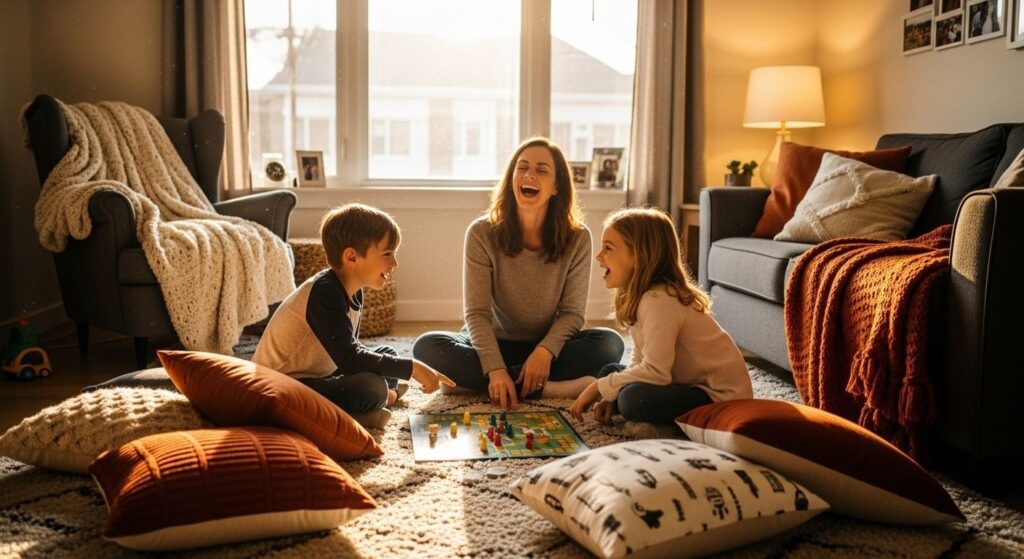
Last week, my 7-year-old asked me a question that stopped me in my tracks: “Mom, why do you always say you’re busy?”
I’d just told her I couldn’t play because I was folding laundry. The same laundry that’s been sitting in that basket for three days. The truth hit me hard—I was choosing chores over connection, again.
Here’s what I’ve learned about the quality time kids need: it’s not about grand gestures or perfectly planned outings. It’s about being fully present for the small moments that matter most to them. And honestly? Most of us are getting it wrong, including me.
If you’re wondering how much quality time your kids actually need, whether you’re giving them enough, and what really counts as quality time versus just being in the same room, you’re in the right place. Before we dive in, if you’re looking for practical ways to connect with your kids, check out these fun activities for kids and conversation starters that make quality time easier. And if you need tools to make connection time more engaging, these board games for kids and activity books have been lifesavers in our house.
The Quality Time Kids Need Isn’t What I Expected
For years, I thought quality time meant doing special activities. Taking them to the zoo. Planning elaborate craft projects. Organizing perfect family game nights with matching pajamas and homemade cookies.
But child development experts paint a different picture. The quality time kids need most is simple, consistent, and focused. It’s not about the activity—it’s about the attention.
Being there FOR your child matters more than just doing things for your child. That distinction changed everything for me.
Ten minutes of undivided attention—phone down, eyes on your child, truly listening—beats two hours of distracted proximity every single time.
How Much Quality Time Do Kids Actually Need?
Let’s get real about numbers because I know you’re wondering: “Am I doing enough?”
Research shows that children don’t need hours and hours of focused attention daily to thrive. What they need is consistency and presence. Here’s what experts recommend:
Young children (ages 2-5): 15-30 minutes of one-on-one focused play daily, plus family meals and bedtime routines.
School-age kids (ages 6-12): 20-30 minutes of dedicated attention daily, whether that’s playing, talking, or working on something together.
Teenagers: At least 15-20 minutes of genuine conversation or shared activity most days (though they’ll never admit they need it).
But here’s the thing nobody tells you: the quality time kids need isn’t just about daily totals. It’s about micro-moments scattered throughout your day. The 3-minute conversation while making breakfast. The 5-minute cuddle before bed. The 2-minute check-in after school.
These micro-moments add up and actually matter more than one big weekly outing where everyone’s stressed about getting the perfect family photo.
Why Quality Time With Kids Matters More Than You Think
Last year, I read a statistic that shook me: 75% of the time we’ll ever spend with our kids in our entire lifetime happens before they turn 12.
Let that sink in. By the time your child is 12, three-quarters of your in-person time together is already gone.
That’s because once kids hit middle school, their world expands. Friends, activities, school, and eventually jobs and college fill their calendars. The window for influence, connection, and memory-making is shorter than we realize.
But beyond the ticking clock, quality time with your kids:
Builds self-esteem: When you prioritize time with your child, you’re sending a powerful message: “You matter. You’re important to me.” That becomes the foundation of their self-worth.
Creates secure attachment: Consistent, responsive time together helps children feel safe and loved, which impacts everything from their stress response to their sleep patterns.
Improves behavior: Kids who get regular quality attention from parents have fewer behavioral problems. It sounds too simple to be true, but it’s backed by research. Attention-seeking behavior decreases when kids actually get the attention they need.
Strengthens communication: Regular quality time establishes patterns of open communication. Kids who talk to you at 5 will still talk to you at 15—if you’ve built that foundation.
Teaches by example: How you spend time with your kids teaches them how to build relationships, solve problems, and show love to others.
My friend’s teenager recently told her, “Remember how we used to have bagel Sundays? Those were my favorite days.” Not Disney World. Not the expensive birthday parties. Bagel Sundays. Never underestimate the power of simple, consistent rituals.

What Counts as Quality Time (And What Doesn’t)
Let me be brutally honest about what I used to count as “quality time”:
- Sitting in the same room while I scrolled through my phone, and they played
- Being at their soccer game while texting work emails
- Driving them places while they wore headphones
None of that is quality time. It’s proximity, not presence.
Real quality time means:
Your full attention. Phone away, TV off, laptop closed. Your child knows when you’re distracted, even if you think you’re hiding it well.
Following their lead. Let them choose the activity. Play the game they want to play, not the “educational” one you think they should play.
Active engagement. You’re not just supervising—you’re participating, asking questions, showing genuine interest.
Connection over perfection. It doesn’t matter if the craft project turns out Pinterest-worthy. What matters is that you made it together.
Simple Ways to Get the Quality Time Kids Need Daily
You don’t need to overhaul your entire schedule or quit your job to give your kids the quality time they need. Here’s what actually works in real, busy life:
Morning Connection (5-10 minutes)
Instead of rushing through breakfast on autopilot, I started setting my alarm 10 minutes earlier. We eat together, talk about the day ahead, or share one thing we’re looking forward to. That’s it. But those 10 minutes set the tone for both of our days.
Try asking a fun question at breakfast. “If you could have any superpower today, what would it be?”
After-School Reconnection (15 minutes)
When my kids get home from school, I stop what I’m doing for 15 minutes. We have a snack together, and I ask specific questions (not just “how was school?”). This transition time helps them decompress and gives me insight into their day.
Have a special after-school snack ritual. My kids love it when I let them pick something fun while we chat about their day.
One-on-One Time (20 minutes weekly per child)
This is the game-changer. Each child gets solo time with you weekly, doing whatever they want (within reason). My daughter chooses baking. My son wants to play video games together. It doesn’t matter what we do—what matters is that it’s just us.
Dinner Together (30 minutes)
Family meals are non-negotiable in our house now. No phones, no TV, just conversation and food. We’re not fancy—sometimes dinner is frozen pizza—but we’re together.
Make cooking together part of the ritual. These kids’ baking sets make it easy for even young kids to help prepare simple meals, and working together in the kitchen counts as quality time.
Bedtime Routine (15-20 minutes)
This is sacred time. We read together, talk about the day, and share highs and lows. My kids are older now, and they still want this time. Don’t rush bedtime—it’s when kids often open up about things bothering them.
Weekend Activity (1-2 hours)
One weekend activity where phones and distractions are off-limits. It could be hiking, playing board games, doing a craft, or just hanging out at the park. Check out these fun outdoor activities for kids for ideas that don’t require much planning.

Quality Over Quantity: Making Minutes Count
Here’s what I wish someone had told me earlier: you can’t make up for absence with stuff or occasional grand gestures.
My friend tries to compensate for working long hours by taking her kids to expensive places on weekends. But her kids would rather have 20 minutes of her undivided attention every evening than another trip to the trampoline park.
The quality time kids need is:
Consistent: Daily small moments beat occasional big events.
Predictable: Kids thrive on routines they can count on.
Responsive: Actually listening and responding to what they say.
Engaged: You’re mentally present, not physically present but mentally elsewhere.
I started keeping games accessible in our living room. When we have even 15 minutes, we can pull one out and connect without any setup time. Game nights became game moments, and they happen way more often now.
What Gets In the Way (And How to Fix It)
Let’s be honest about the obstacles to quality time, because knowing the enemy helps you fight it:
The Phone
Our biggest enemy. I had to literally put my phone in a drawer during quality time because I couldn’t resist checking it. Now I use “do not disturb” mode from 5-7 p.m. on weekdays.
Fix: Create phone-free zones and times. Your notifications can wait 20 minutes.
Exhaustion
Working, managing a household, existing in this world—it’s draining. By evening, you have nothing left to give.
Fix: Quality time doesn’t require energy-intensive activities. Lying on the couch reading together counts. Cuddling while watching their favorite show counts. Lower your expectations of what quality time “should” look like.
Guilt
“I should be doing more.” “Other parents do more.” “I’m failing them.”
Fix: Stop comparing. Your kids don’t need you to be perfect—they need you to be present. For practical guidance on letting go of perfection, these parenting books helped me tremendously.
Busy Schedules
Between activities, homework, and life logistics, there’s barely time to breathe.
Fix: Be ruthless about overscheduling. Kids don’t need to be in five activities. They need time with you more than they need another enrichment class.
Siblings
How do you give individual attention when you have multiple kids?
Fix: Wake up or stay up 15 minutes early/late with one child. Assign different bedtime slots. Take one kid on errands while the other stays home with your partner. It doesn’t need to be equal every day, just balanced over time.
Age-Specific Quality Time Ideas
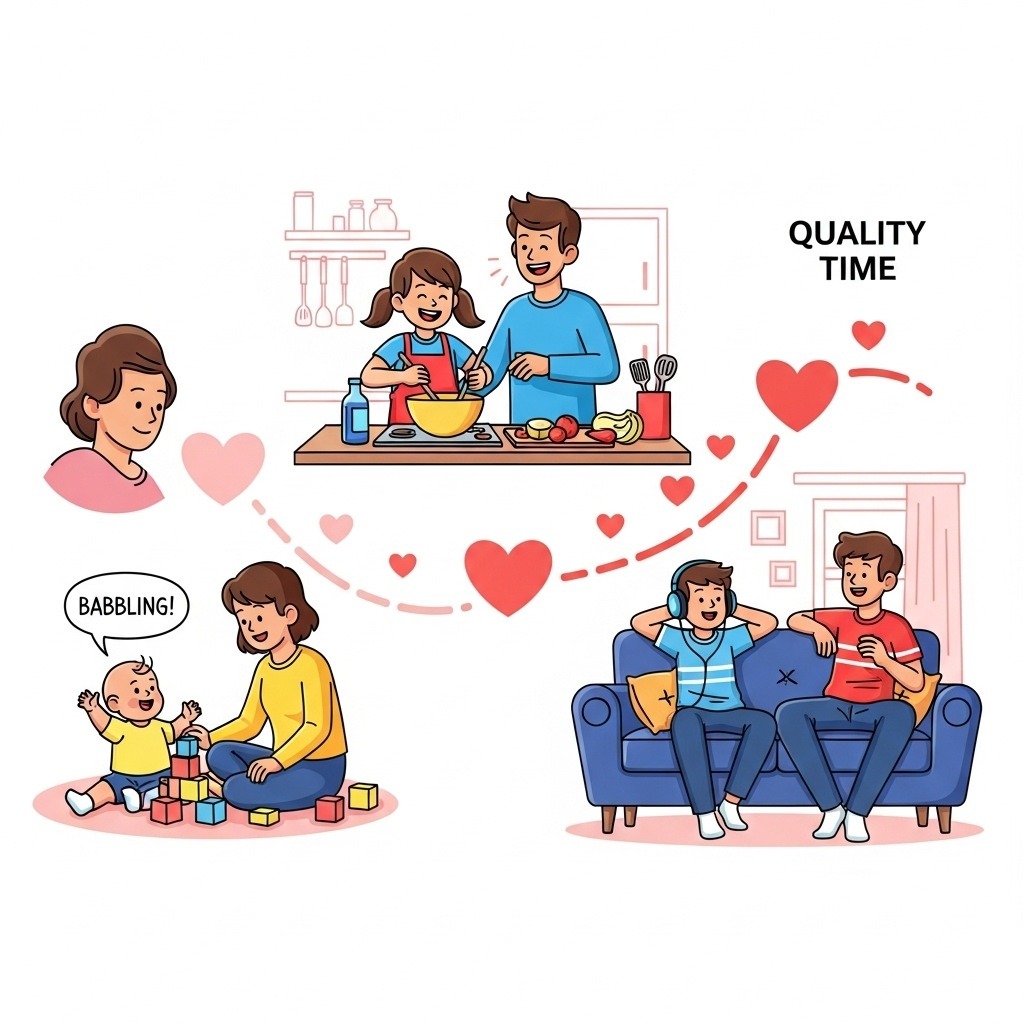
What quality time looks like changes as kids grow. Here’s what works for different ages:
Toddlers and Preschoolers (Ages 1-5)
They need physical play, simple games, and your full attention during their chosen activity. Follow their lead, narrate what they’re doing, and get on the floor with them.
Activities: Building blocks, reading picture books, coloring together, playing pretend, dancing, and sensory play.
Early Elementary (Ages 5-8)
They want to talk about their interests, play games with simple rules, and help with grown-up tasks.
Activities: Board games, cooking together, crafts, outdoor play, reading chapter books aloud, “helping” with chores, and trying these easy recipes for kids.
Late Elementary (Ages 8-12)
They’re developing their own interests and personalities. Quality time often happens side-by-side rather than face-to-face—working on projects together, learning their hobbies, and having real conversations.
Activities: Their sports/hobbies, video games together, shopping, cooking real meals, hiking, teaching you their interests, and working on projects.
Teenagers (Ages 13+)
They seem not to want your time, but they desperately do—just differently. Quality time often happens in the car, late at night, or during casual activities where talking feels optional but happens naturally.
Activities: Driving them places (captive audience!), late-night talks, watching their favorite shows together, letting them teach you something, respecting their need for space while being consistently available.
The Impact of Small Moments
My daughter is 9 now. The other day, she was listing her favorite memories, and I braced myself for the Disney trip or her elaborate birthday parties.
Instead, she said: “Remember when we used to make pancakes on Saturday mornings and you’d let me flip them even though I got batter everywhere? And when we’d have tickle fights before bed? And our special handshake?”
All small moments. All free. All simple.
The quality time kids need isn’t what society tells us we should provide. It’s not Instagram-worthy adventures or expensive outings. It’s a consistent, focused presence in the ordinary moments.
Your kids won’t remember if the house was clean or if you worked late some nights. They’ll remember if you showed up for them. If you listened. If you made them feel like they mattered more than your to-do list.
That’s the quality time that builds secure, confident, emotionally healthy kids who want to spend time with you even when they don’t have to anymore.
Frequently Asked Questions About Quality Time With Kids
Q: How much quality time should I spend with my child each day?
There’s no magic number, but research suggests 15-30 minutes of focused, one-on-one attention daily makes a significant impact. This doesn’t include meal times, bedtime routines, or being in the same room—this is dedicated, phone-free engagement. That said, micro-moments throughout the day (a 3-minute chat here, a 5-minute cuddle there) also count and can be just as valuable. The key is consistency and genuine presence, not hitting a specific minute count. Quality trumps quantity every time.
Q: What if I work long hours and can’t spend much time with my kids during the week?
Focus on making the time you DO have count. Morning and bedtime routines become crucial—even 10 minutes of focused attention before school and 15 minutes before bed creates a connection. Weekends can include longer quality time sessions. Importantly, working doesn’t make you a bad parent. Kids understand parents work; what hurts them is when parents are physically present but mentally/emotionally absent. Be fully there when you’re there, and don’t underestimate the power of small, consistent moments.
Q: Does quality time have to be an activity, or can we just hang out?
Absolutely! Some of the best quality time is “just hanging out” together. Lying on the couch reading while your child plays nearby counts if you’re emotionally available and occasionally engaging. Folding laundry together while chatting counts. The defining factor isn’t the activity—it’s your attention and availability. Many kids actually prefer low-key hanging out to structured activities. Follow your child’s lead on what feels connected to them.
Q: How do I balance quality time between multiple children?
You don’t have to make it perfectly equal every day. Aim for balance over a week or a month. Some strategies: assign different bedtimes so each child gets solo time; rotate who helps with specific tasks (one child helps make dinner Monday, another Tuesday); wake up early or stay up late with one child occasionally; take siblings on individual errands. Even 10 minutes of focused one-on-one time weekly with each child makes them feel special and seen.
Q: My teenager says they don’t want to spend time with me. How do I give them quality time?
Teenagers still desperately need quality time—they just express it differently. Try side-by-side activities rather than face-to-face talks: drive them places and chat in the car (captive audience!), watch their favorite show together, let them teach you about their interests, respect their “no thanks” on activities but stay consistently available. Quality time with teens often looks like being around when they finally DO want to talk, which often happens spontaneously late at night or during casual moments. Don’t give up just because they’re pulling away developmentally—they still need you.
Listen, you’re probably doing better than you think. If you’re reading this article, you care enough to show up. That’s already half the battle.
The quality time kids need doesn’t require you to be a perfect parent with unlimited energy and resources. It requires you to be present—really, truly present—for small moments every day.
Put your phone down. Get on their level. Listen like what they’re saying is the most important thing you’ll hear all day. Because to them, it is.
Those dishes can wait. The laundry will still be there tomorrow. But your kids? They’re only this age right now. Make the moments count.